faea gaming: February '26
Hi, everyone. This month marks the year anniversary of me taking and using this site seriously; my first uploaded post was last year’s February entry of this very journal. Look how far we’ve come… I’ve made a lot of changes to the site’s layout over the past few weeks to make it a little nicer and feel a little better structured. I want to keep working on it for a while, make it feel nicer and make it look a bit better and more personal. I’ve basically been riding on the same layout since I started… feel like it’s time to get some of those changes going that I wanted to make a year ago. There’s also a guestbook now, as well as the comment boxes under each post, if you want another avenue to say things to me: feels apt considering how fragile the internet at large has been feeling of late. (I wrote this out the day before learning that myrient is going down... fuuuuck)
I think with this, I’m probably going to end up cutting off my Substack pretty soon. I think I said recently I’m not going to upkeep it much longer since I want to be reliant on these sorts of external services as little as possible. I’m still probably going to keep reposting to the places I do have a notable following for a little bit, but I’d like to cull that as well once I feel more comfortable that people are actually, like, using this site. I’d like to get everything feeling as independent as possible… not that I’m buying a domain just yet :p.
It’s also my birthday today. Say happy birthday to me NOW
Games I Played This Month
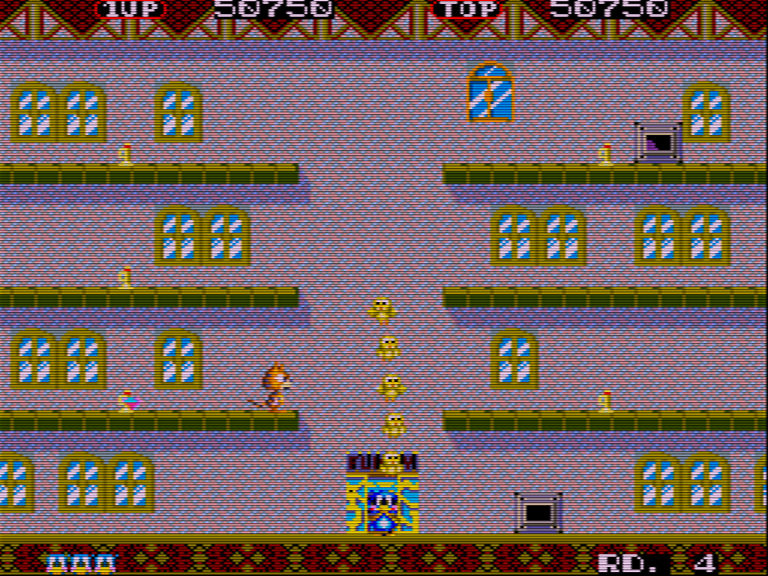
Flicky
A fairly unassuming maze-game platformer: herd all the chicks in a level and bring them to the start of the level whilst avoiding hazardous cats and lizards that kill you and separate your line of chicks, or eliminating them temporarily by collecting one of the finite weapons on the level and throwing it at them by jumping. The snags of this game appear rather quickly: weapons can be taken downwards in a level but not upwards, as jumping will consume them; and careless movement will result in the levels' limited weapons being accidentally picked up and wasted, especially as the placement of the chicks often feels intended to cause just that. Furthermore, movement itself has some interesting quirks – the jump always reaches a fixed height, and hitting a wall while airborne bounces back a set distance and height – which both allow creative methods to gain extra distance, and make moving around the tighter, less spacious levels an ordeal in itself.
What ties it all together is the level timer: a 60 second timer before enemies begin to spawn is rather generous, but the max score bonus – 20,000 points per stage, double the next time bonus of 10k – requires clearing the level in under 20 seconds, pushing all of proactive play, routing both the quickest route and one that allows access to weapons when it matters, and a perfect grip on the tight yet unwieldy controls. This bonus is the main source of points, significantly ahead of the bonus for finishing with a full chain of chicks, meaning collecting any reasonable amount of score extends requires for you to push for these fast, confident level clears at all times – particularly apt as playing too passive in certain levels can get you cornered by all three enemies with no real way to escape the pressure; the push for speed through scoring is setting you up to succeed at a base level for survival, as well.
It's fun! My PB was about Stage 20, past that I don't really have the drive or the chops for routing or wrestling its movement at the moment. Not feeling the draw to grind this one like some other games, but think it might be nice to come back to once in a while.
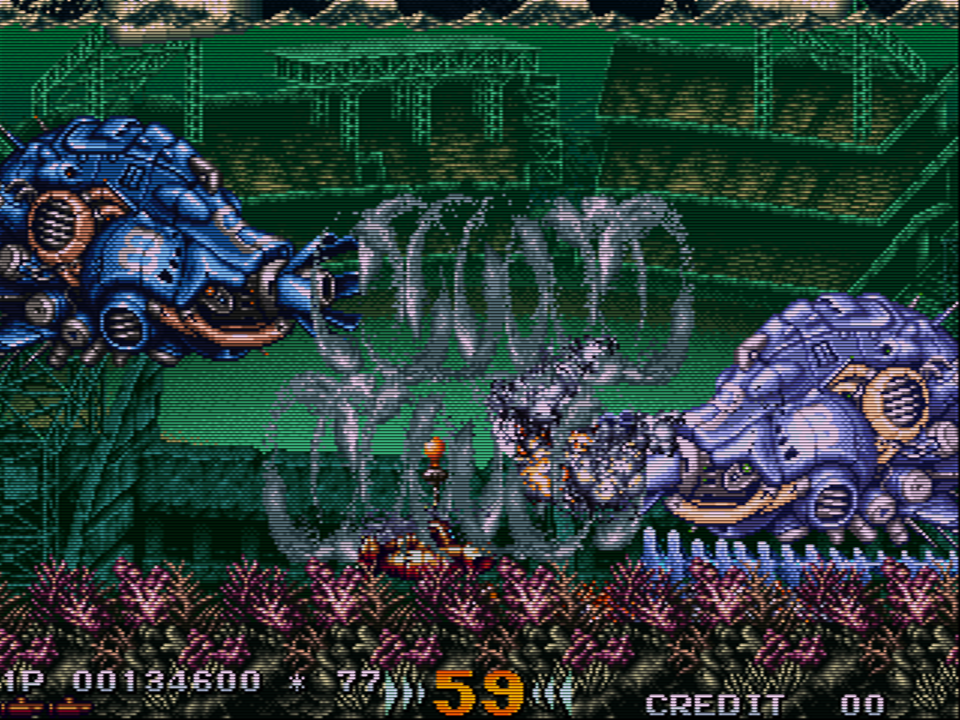
In the Hunt
The submarine-shmup framing does a lot to force situations with uniquely difficult positioning demands. As well as a standard frontal shot, secondary-fire acts as an upwards shot: underwater this makes quick work of a lot of the game’s submarine threats, as they can only fire forwards and up as well, so being as close to the seafloor as possible is often a very safe position to be; and while on the surface this fires bullets upwards as the only means to clear out the often heavy density of airborne threats. The result is a game where the two most important positions on the screen are the furthest ones away from each other, feeling like a constant tug-of-war of routing and tactical decision-making where any position feels extremely committal: sit at the bottom to clear out waves of subs and get showered by aerial missile fire, or sit on the surface to take down aircraft and risk being flushed out from below by enemy subs with no way to counterattack. Your shots can collide with and break enemy missiles, so being deep underwater can then, perhaps seemingly contradictorily, help shield against directly vertical aerial fire whilst surfacing against a storm of missiles can be incredibly tight and risky, though staying underwater as enemy airfighters and their fire builds up and up and up results in heavily restricted horizontal space to move around underwater threats, so making that tricky first surface as early as possible remains important.
It’s a great core that’s supplemented by level design that pushes the underwater dynamic in all sorts of different directions to create a host of different pressures. Stage 3 plays by the shallow waterside of a city and gives practically no room to maneuver vertically around the tidal waves of aerial fire, but allows very easy access to the surface to deal with its source; meanwhile the upwards-scrolling Stage 5 exacerbates both the strengths and weaknesses of verticality through constantly forcing you upwards: giving you an extreme advantage whilst managing to stay underneath enemies, but immediately tacking on extreme, unkillable pressure when any manage to scroll below you. Physical space is manipulated and abused to push against you in a variety of novel situations that feel refreshing in a genre space where my experience so far has had so little of this! The main reprieve is the lack of autoscroll, the camera instead scrolling forwards (but not backwards) with your movement allowing some control over your space and the pacing of the game, but the result is the game being able to fill the screen with even more enemies, even more projectiles from different angles, and create situations that feel suffocating even without the pressure of a scrolling screen.
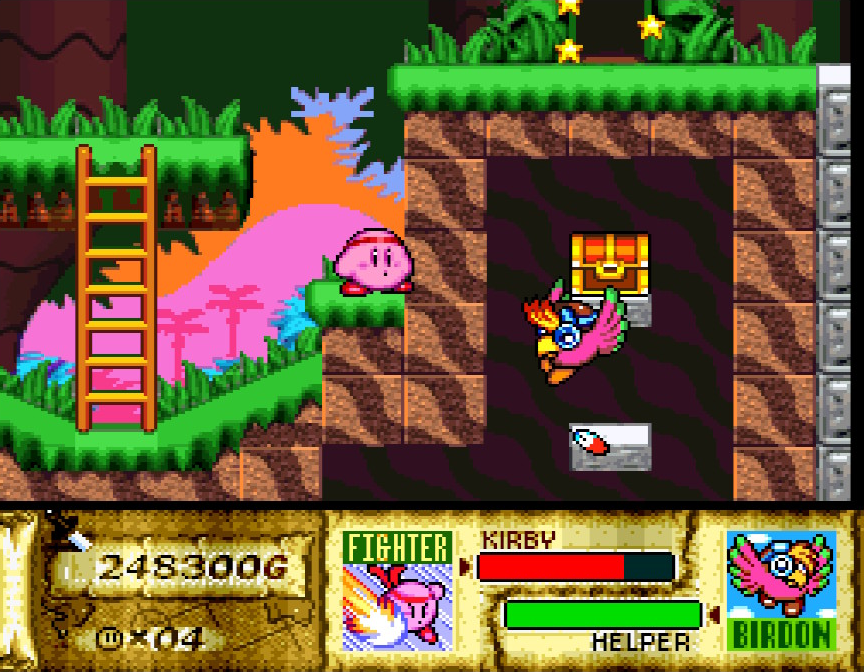
Kirby Super Star
Not particularly impressed by this one, still: Kirby’s Adventure is one of the most ‘elegance-through-simplicity’ games I’ve ever played, and one of my first experiences in Super Star was getting the copy ability where you have to run back and forth a bunch to power it up, and realising upon deciding I didn’t like it that my only way to drop it was to summon and then destroy a CPU helper ally. The move from single-button abilities to full-on movesets is one of the least convincing progressions I’ve seen: the minimalism of the former makes every powerup immediately intuitive to understand and use, whereas every time I grab a new ability in Super Star I’m having to open the in-game movelist and get overwhelmed by six context-less move names and inputs. The simplicity of Adventure’s abilities makes each ability feel greatly unique in application from each other, whereas Super Star’s feel like, even with their uniquenesses in mind, they often blend together far too much for most to interest me. And this isn’t just down to the moveset breadth itself – even Sword’s firing projectiles on its basic attack! Simplicity also allows levels designed not necessarily around particular copy abilities, but with them in mind; each screen has abilities that are clearly good but not necessary, and bad but not unusable, for its setups, making it both fun strategically to intuit and bring a good copy ability for a section, and fun kinetically to bring a less-suited one and attempt to blow through it anyway. Super Star feels like simply cannot do this under any context, because each ability gets access to so much. It rather feels like copy abilities are a preference, intended for each person to gravitate towards one and hold onto it and gets used to its peculiarities (an inference I made before playing Milkyway Wishes, which is probably all but confirmed by that one :p ), but in part due to aforementioned issue of level design being unable to accommodate all these tools, regardless of how fun an individual moveset is, the context it’s being applied to is that of an action sidescroller with underwhelming level and enemy setups.
Oh and they got a block button in this one, that’s kinda silly.
Played this one through with a friend and enjoyed that experience honestly more than it sounds like from how I’m talking about it, but after playing Dyna-Blade solo I didn’t really have it in me to do much more than that by myself.
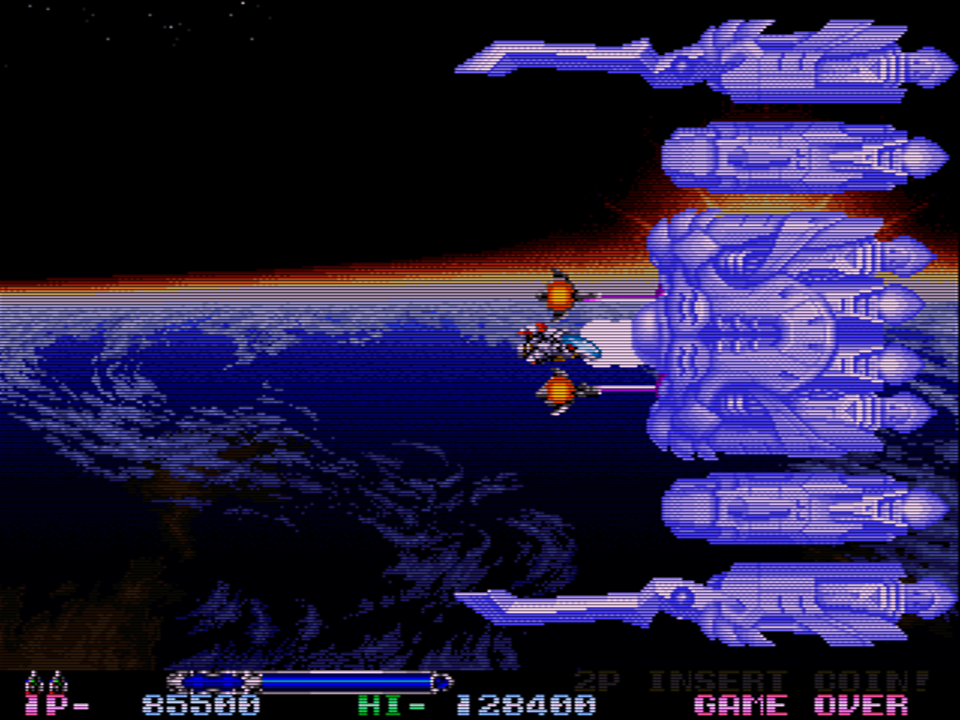
R-Type Leo
Lovely, fluffy little shmup with perhaps a little too much bark compared to its bite. Everything’s very well-considered: three swappable shot-types with very different applications – a fully-horizontal beam for pure damage, diagonal bouncing shots for clearance in tight spaces, and vertically-tracking shots for less but more reliable coverage – options fire opposite to the ship’s horizontal movement giving weak but noticeable leftward coverage as well as a little extra movement consideration, and hugely creative levels that use terrain to suffocate space and restrict movement in really interesting ways – and then there’s the alt-fire, which sends both of the ship's pods out as giant homing bullets, passing through terrain and almost strong enough to act as a pseudo-screenclear – only limited by a very short cooldown meter, and by leaving them out too long causing the options to stay suspended in the stage until picked up manually. Though it makes for a calmer experience than the majority of arcade shmups, which is well-appreciated both for being an arcade shmup I could reasonably take someone through in co-op without much credit-feeing, as well as being someone not quite cut for their typical level of difficulty in general!, I think I’d appreciate it much more if that kinder difficulty weren’t dictated by an extremely powerful, visually-commanding homing shot.
^ I played all this then somehow, against all odds, found a Japanese Leo cabinet at an arcade. Feel like that’s gotta be an unbelievable pull? Anyway I think I appreciate the JP ver a fair bit more just because it has checkpointed respawns, because the balance feels a fair bit sharper under that context. Rather than death immediately dropping the first powerup level back onto you, allowing you to immediately start blasting the homing charge shot but not letting you do much else, whereas checkpointing allows checkpoint placements to both be near enough to power drops to give you a leg up, and far enough away from them to force you to play without charge shot access for a while. It’s neat! Very kind introduction to checkpointed shmups, seemingly.
Pocky & Rocky
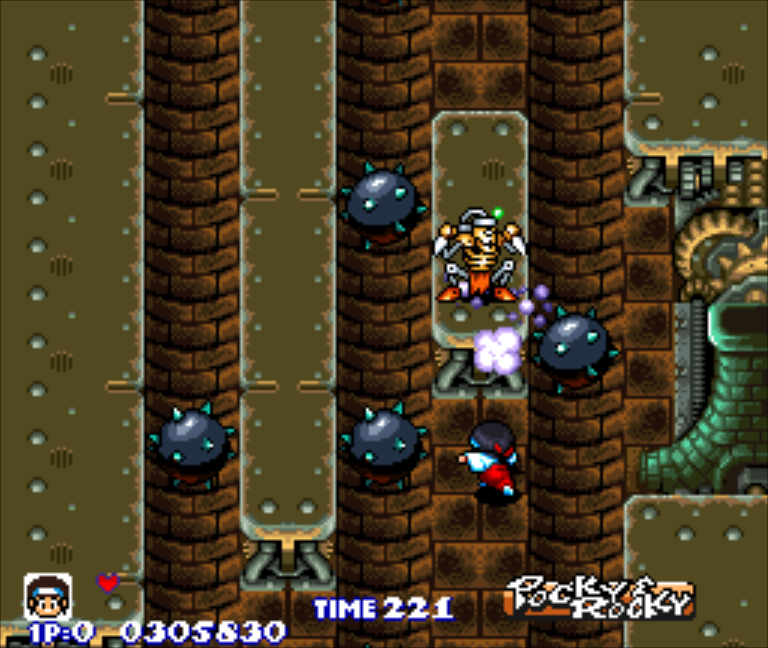
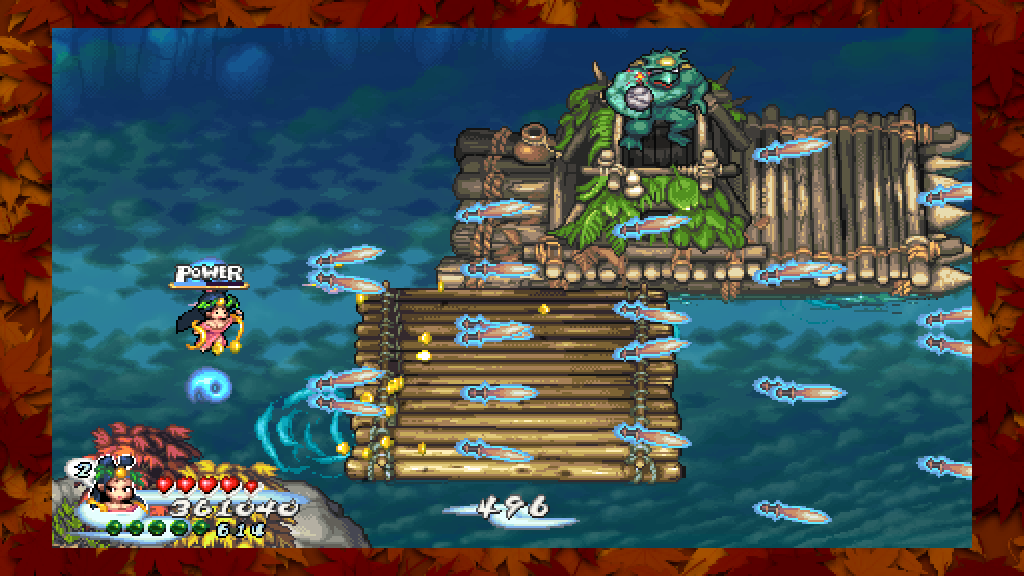
Wrote about this one fully, which you can read here, but yeaaaahhhhh this one was lovely. Learning this one is very knowledge-heavy more than execution heavy, which might be a little concerning but the later challenges lean more into interesting proactive play than memorising cheap shots (which does happen for the whole game :p but you get the tools to deal with them all reasonably), and good execution is still important and interesting throughout most of the game’s challenges. Game’s like a little melee deflect-heavy which, combined with some enemies having low-telegraph projectiles, can make safe play feel very slow, and some autoscroll or cycle-driven sections can feel similarly sludgy (fuuuuuck the stage 5 spiky ball cycles!!!!) – but that’s really all the bad I have to say about this one. I love aiming being tied to movement direction: heavy optimisation encourages some really interesting movement and positioning, and the best challenges in this game really make it hard to dodge around enemies while still tacking damage onto them. I loooooove the resource game in this: health being a meter rather than a strict one-hit-kill lives system, with shot power dropping from taking too many hits. Dropping too much power and losing shot range transforms otherwise-easy challenges into something really challenging, and while it’s always possible to recover from almost any situation thanks to generous health and power refills, even the true unrecoverable death spirals are valuable in how playing with such harsh range restriction forces learning intricacies of sections that stay helpful even when playing well. And I love how the generous recovery potential allows for the game to be really, really fast-paced and high-pressure without actually being ridiculously, painfully hard. Enemies and projectiles pop out so quicky and close with so little warning, that are individually easy to avoid but hard to get through sections without taking some hits – bringing that recovery dynamic straight to the forefront. And it’s so light, visually nonexcessive, and gentle! It’s an aesthetic style that escapes both the creeping bombast of the typical ‘90s arcade game, as well as the direct response of the sometimes sickly-sweet ‘cute’ games.
2p is also fun! Theoretically it seems far easier since nothing in the game scales to account for a second player, and the game’s challenges being so focused on dynamics of shot range makes being able to cover two places at once… kinda busted :p, but so many little details make cooperation really kinda hard: sharing screen space, so the leading player is always gonna be off-centre and have less time to react to enemies coming on-screen; the most resourceful choice being to have one player on spread and one player on fire, meaning one person gets stuck with a far worse shot in basically all contexts; player collision making claustrophobic sections kind of tricky to navigate; and dashing into your partner, like, basically just killing them in most situations?? It’s cute!!
Babushka's Glitch Dungeon
What’s a very interesting core conceit on paper – an extremely limiting base moveset that can be augmented by swapping between ‘spells’ that act as passive movement tools – feels very unexciting in execution, as all spells save for one are rather basic and historically well-explored platforming options: the high jump, the wall climb, etc. Nor do the levels frame either the tools themselves or the ability to combine exactly two in interesting ways; the levels rather take focus away from these tools and instead lean into individual level gimmicks – particularly confusing with only four spells throughout the game – resulting in feeling like rather pedestrian platformer levels than the creative problem-solving puzzler that occasionally feels desperate to claw its way free. The little puzzling it does put in front of you is a great demo for its own potential: running back through rooms to pick up an earlier spell, then having to perform odd navigation to bring it back forwards without access to the ‘intended’ set for that room; and parts of the final level are a legitimately great showcase of how a mechanical gimmick can interact with these movement options in really interesting ways. So I hope if jakeonaut revisits this concept that they can tease out the puzzling side of this a lot more, because I think that could be something really great.
Contra: Hard Corps (JP)
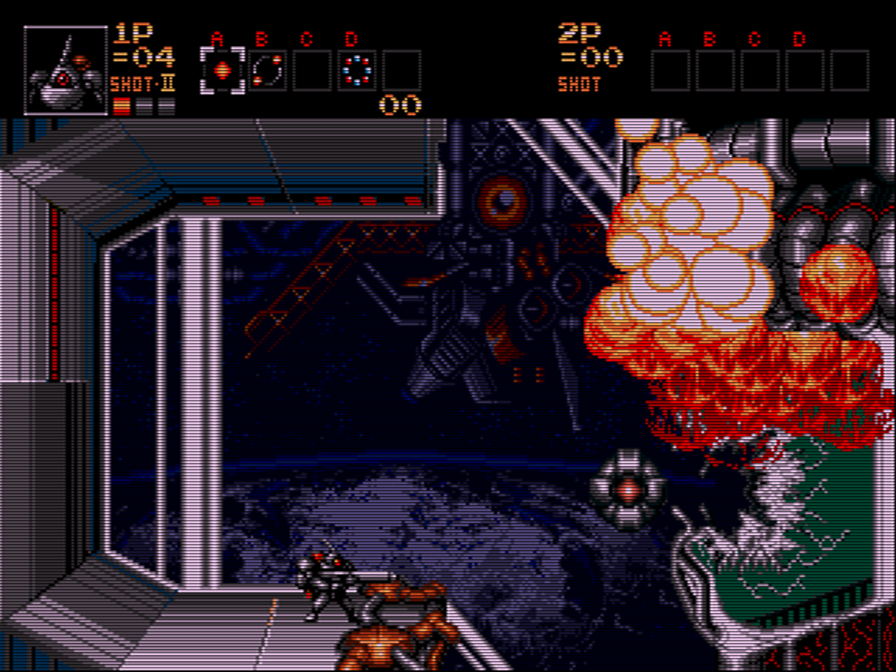
Bosses are the driving force of the game but feel very unconvincing throughout, starting and remaining very simple. They perform single, straightforward attacks sequentially, always waiting until the previous is finished before starting the next, leading to completely static responses with no way of teasing out dynamic or novel situations; once you’ve learned a boss’s attacks (likely after getting hit a few times as they tend to come out very fast), it’s likely you can dodge them consistently and rather thoughtlessly as they never demand much more intricacy than “move to the side on short notice” or “jump a few times in a row” after a short tell. The depth of these fights rather comes from learning more aggressive safespots and optimising damage from positioning and weapon choice, which is enough to stay interesting for a while but feels straightforward enough to not feel like it has longer-term staying power. Level sections usually act as a formality and a stop-gap between these setpieces rather than anything meant to offer challenge, though are mercifully shorter than Gunstar Heroes’, the game this one’s obviously so indebted to. It’s clearly driven by spectacle above all else, and that spectacle is often very entertaining, especially when the game leans away from the What If Explosions Were So Freaking Awesome action movie smell and gets a lot sillier, but it wears thin with familiarity after repeated plays.. which is a bit of a killer for a game that expects full replays, with how much weaker the standard shot is than the character-specific weapons lost on death and game over.
The JP version has a 3-hit health bar compared to the overseas versions’ one-hit death which… for once I kinda get why the others are so much more punishing! This game is genuinely shockingly easy with that much of a health buffer plus having the ability to more actively manipulate which weapon is lost on a life loss, making even a 1cc possible after a single-digit number of plays, and I can’t lie that the ease of that grind made it a pretty appealing game to keep pushing at. But I just don’t think the challenges are interesting enough to justify beating against a high level of difficulty – building around very tight yet very simple and linear challenges is just not a very interesting paradigm of difficulty to me – and having it be easier feels better for a spectacle-driven game to keep its momentum going and keep its ideas feeling fresh and fun.
Contra (NES)
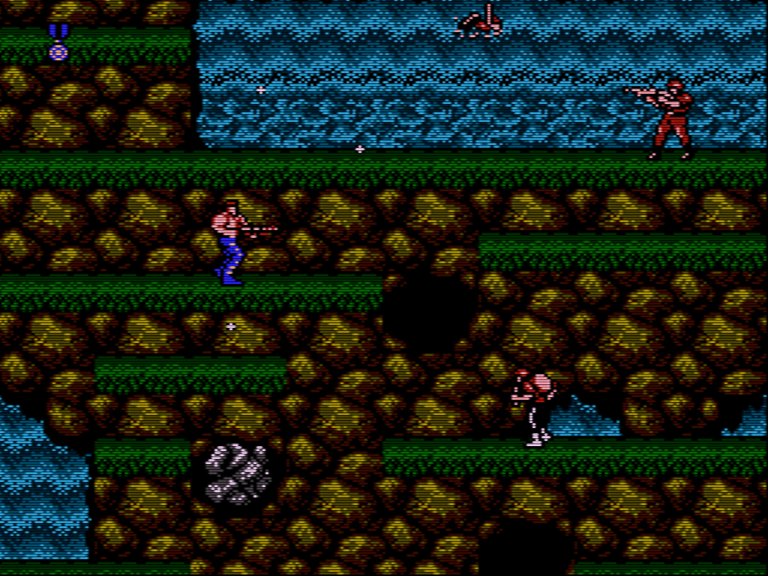
I got interested in trying these when I called run-’n’-guns ‘platformer shmups’ in my head, and that influence shows clearly as early as Stage 1: the complete loss of standard vertical movement in the transition from flight to platformer is made up for by always having multiple elevations of terrain for both the player and enemies to occupy and move between; enemies can still threaten space from all sides, and dodging the much more restrained amount of fire gains the flexibility of either jumping or ducking through bullets, or moving between layers to gain a more advantageous offensive and defensive position. Both high and low layer positions are pushed against interestingly: shooting directly downwards is only accessible midair requiring a committal jump to access, making targets below often very difficult to shoot without the spread shot equipped; but in turn the low layers are often treated as punishments with harder challenges to deal with: an interesting setup that stuck out to me in Stage 1 is that being on the lowest layer makes the first spread shot pickup very easily missable without waiting to shoot it down until it scrolls to the end of the screen near the platform that allows you to reach the top.
It's not a perfect lens to view the game under, though: Stage 1 is a very promising, albeit fairly light opener, that presents dynamics that are rarely played into in future levels: the platformer stages begin to spend less time threatening verticality, with the few enemies capable of aiming at the player being slowly phased out in lieu of ones that simply fire forwards more often, and stages adding more explicit platforming challenges in the form of hazards and platforms on cycles; these aren’t bad per se, with it still being able to force tight platforming through multiple layers of forwards shots in order to position to kill an enemy, but nonetheless feel as though they lean away from the conceit that made it unique and towards more traditional action platforming. The base levels are interesting in their own right through changing the perspective to a shooting gallery with targets entering and shooting from a ‘background’ layer in a tight room with massively-restricted movement, accounting for this by allowing the crouch to completely dodge all bullets, and then accounting for this by creating situations where, if enemies are not controlled enough proactively, there can be so many bullets on-screen at all times to almost lock you into a soft fail-state of just not being able to leave prone position to hit the non-respawning targets. These are impressive both from a technical perspective – it just wouldn’t be the same if the seams weren’t visibly about to burst! – and from being a further reiteration on the shmup framework, but the near-full invincibility on crouch makes them feel very linear and the perspective makes a game with already very poor bullet visibility even more of a struggle.
Metroid (FDS)
The AWESOME power of the Famicom Disk System™ makes this go down just a little nicer, not because of the battery save system when we’re probably all bypassing NES’s password system with save states anyway, but because a lot of the ambient lag on this thing is just gone. I didn’t mind it at all in NES – frankly didn’t notice until playing the two literally one after the other – but what’s easily a very slow-paced game without speedrunner knowledge and skill just gets a little bit smoother with a performance boost. The extra sound performance is cool as well, though while all the fancy hit and pickup sounds are very cute I can easily understand why the NES version’s simple, melodic powerup jingle stuck rather than the messy overlap of sounds on FDS.
Also, Ridley is actually kind of a fight now! The AWESOME™ POWER™ OF THE FAMICOM™ DISK™ SYSTEM™ means his attacks have a random spread to them, rather than firing in the same fixed arc until you walk up to him and shoot his belly until he dies. He almost killed me!
I was worried this wouldn’t hold up to scrutiny on a repeat playthrough with how knowledge-driven it is, but everything strong about it still remains so. What I noticed is that knowing where all the key upgrades were was making me beeline past the missile and energy tanks, so my knowledge and experience was, in a sense, counterbalanced by that, and keeps the really good combat that lives at the front and centre of the moment-to-moment really interesting. I'm mid-writing a fuller piece on this (read: waiting for the motivation to do, like, two more editing runs), which is why this isn't very well explained :p.
Snow Bros.
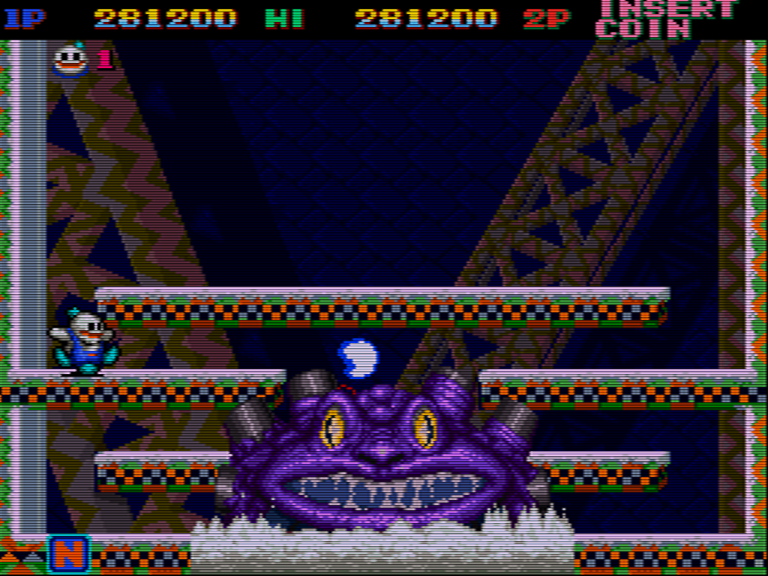
‘Bubble Bobble if it remotely followed the tenets of traditional game design’ is a pretty good pitch! Shoot enemies to cover them in snow and pacify them, fully cover them to turn them into a snowball, roll them down the screen into enemies and other snowballs to cause massive chains. There’s so many little nuances to this: moving to the top of the screen is both safer and gives snowballs more coverage, so do I cover enemies just a little to stun them and move up as fast as I can, or stop to encase enemies fully so I can get bigger and more reliable chains? Snowballed enemies start rolling when hit by another snowball to cause a chain reaction but do not drop items, including very valuable powerups, so do I set up a level for more reliable and easier clearance or do I let enemies wander around to try to fish for a powerup I don’t have? How do the powerups I do have affect the way I approach a stage? With extra speed and projectile power I might be able to hit a key space-controlling enemy before the level fully starts, but without I might need to take a different approach; to this end, entering a rolling snowball grants full invincibility during and for a second or two after the roll, letting me zip across the screen at lightning speed to safely carry myself into an otherwise impossible situation, but lowers overall chain – and by extension, resource-gathering – potential.
The biggest snag is enemy behaviour, which though appearing deterministic can seem very random in motion: if enemies are left for too long, they can cause major issues by walking themselves into really, really unsafe positions to approach, potentially leaving you with no real choice but to wait until they decide to move away; or simply just run away from you on the other side of the level and waste your time. It’s really annoying when it happens, but often encourages a really fast, really aggressive playstyle: get up there and control all the important enemies as quickly as possible, and pinball them all down before the variance gets a chance to get brutal. And honing that speed is necessary for the later levels regardless of variance just due to how well enemies begin to control space; if you aren’t taking care of key enemies quickly it’s easy to get pinned with no way out. Routing levels down to a hard science is important to keep things from getting of hand, but the execution is both demanding and creative enough to allow clever improvised recoveries from difficult situations.
I watched about 5 minutes of a score run and my brain exploded
Pocky & Rocky: Reshrined
It's good! It's by and large more of what makes Pocky & Rocky tick: a lot of the level setups, especially by the end, pressuring in ways that expect both high knowledge and solid, consistent execution – albeit feeling a little more lenient in both aspects – though a lot of the nitty gritty changes don't end up feeling so good, either failing to target the awkwardnesses of the original or weakening what it does do very well. The most pressing is that while some levels are very sharp, a lot feel like they encourage very slow play: instead of pressuring you to move forwards through their setups, constantly pushing you through more and more enemies and expecting the confidence to deal with it all, many of Reshrined's setups both allow and are completely pulled apart by moving backwards, taking as many static enemies off-screen as possible to deal with one enemy at a time. Stage 3's water sections are the highlight of this: giant pillars of rock and water emerge from the ground who, if let grow to their fullest size, launch streams of undodgeable projectiles that force standing still and deflecting. Spend too much time attacking them to outright kill them and the waterborne enemies constantly add projectile pressure, or chip off small parts of them at once to deal with everything else and risk them growing back whilst preoccupied and firing at you while unprepared. Except... none of this works in motion; neither enemy type is able to move and the screen is able to scroll backwards in these sections, so these enemies can be taken literally one at a time by scrolling everything else off. And this one's eight stages long, so slowing down the pace even more is really noticeable!
But the camera doesn't act as if you'd ever want to walk backwards, often scrolling up out of nowhere to centre on a landmark of dubious importance while you're trying to fight enemies underneath you, who are now completely off-screen while you're hugging the bottom. These aren't usually strict camera locks either – I'd be fine with that – but you can usually end up just wrestling control back after a few seconds. It's bad!!
The other main change is that the resource game feels a lot different: I'm still uncertain what causes power to drop, but it feels like losing one heart of health drops shot power by one level – but regardless of the underlying system what's immediately noticeable is that single hits can immediately drop a level of shot power, but most of the time the power pickup will just drop right next to you (on Normal; this doesn't happen on Hard). It leads to a very strange feeling resource game where taking single strays can be legitimately punishing, and multiple hits at once (which isn't unlikely; it is a Pocky & Rocky :p ) can send you straight back to base power... but you might just get to pick your power straight back up instead. Being at base power isn't so bad here due to the new powered shots (accessed by mashing the shot button... ew), but using those is often a further hit to pacing as most of them are summons that either remain on the floor and afford enemies being lured into them rather than using them aggressively, or need to be repeatedly maintained. The leg up with the shot power changes are the game's shops, which have a chance (which is not technically random it's deterministic but unwieldy enough to be effectively random for most people) to drop, among other things, a max power drop for any of the three shot types in exchange for coins that drop from enemies. As more expensive shops give better drops, with the most expensive being a guaranteed extend, the surprisingly well-considered money economy plays out in a way that gives a leg up to struggling players by allowing them cheap bonuses, but rewards holding onto that money for a go at better shops. (You can get so many extends in this game by the way, it's kind of ridiculous.) But you could still argue that money drops from enemies encourages killing everything, even in situations where you're clearly expected to move through, and while that feels a little bit of an excessive criticism, I can't say I haven't felt that pull a little bit.
So it ends up being a longer, slower, more punishing but ultimately easier spin on Pocky & Rocky – the lower difficulty being especially standout after unlocking Free Mode and being able to choose a character, as the new characters all feel noticeably stronger than Pocky & Rocky themselves: long jumps, flight, homing and lock-on shots; it's good fun, to be honest, but definitely doesn't help a game that feels like it has a fairly weak bite: I was able to 1cc on both my first full plays after, like, 30 minutes of practice on the early stages, and my first Hard run that made it past Stage 2 was a 1cc as well.. feels like deathless is the thing to really push for in this. So I can see it being a good game for people to get their feet wet in these arcade-y improvement-grind games, but I'm not sure if it has much staying power for me.
~*ʚїɞ*~
Thank you for reading, as always. These lists have been getting padded by all the arcade games I’ve been sorta windowshopping, but I feel that’s going to start slowing down soon. I’ve also been playing a few other arcade-y games I didn’t want to write about this time… Galaga ‘88, Streets of Rage 2 on Hardest, Mushihimesama, to name a few. A lot of this feels like I’m sorta building a foundation of games to cycle through, that I can slowly, slowly, slowly get better at.. and maybe dream about 1ccing in, like, five years or so :p. Do you think girls find girls who can 1cc really hard arcade games attractive or desirable. No reason.
And as I mentioned earlier, I went to an arcade for the first time this month. It was very cool… even if they did have Altered Beast and Golden Axe cabinets. I, again, went with the intention of basically windowshopping for cool games, but this time with them being put right in front of me so I don’t have to look for anything :p and I’d say it worked out well. Aside from R-Type Leo, the standouts I played were Snow Bros. (I’d played this one before, but playing at the arcade was coincidentally what made it click, so it counts), Galaga ‘88, Salamander 2, U.N. Squadron (I also tried the SNES one a little bit ago, it’s cool how similar but different they both are), Super Pac-Man, Dig Dug, and some anime-styled melee action sidescroller I didn’t get the name of that also just has gradius options, bullets and all, very silly. The venue I went to felt more geared towards kids and families (probably helped that I went during a half-term weekday :p ), which is of course valuable, but I think it'd be fun one day to go to one where I can meet all the 40 year olds who got way too good at Final Fight and be unable to scrape the top scores in all the popular cabs. Really, I don't know how much Arcade Culture in this sense exists any more, but… would be fun.
And, again, don't forget to read my most recent piece, as well. Love you all. See you next month. ~♡