Makai Toushi Sa・Ga for the WonderSwan Color
Espers still remain the most fun, dynamic and fluid class I’ve ever had the pleasure of using in an RPG. Their ridiculous, haphazard gameplay basically defines SaGa I to me: they’re a magic-focused class whose known spells have a chance to change after each battle, constantly cycling different spells in and out forcing adaptation to their constantly-changing abilities which can be detrimental just as often as beneficial; it’s just as possible to have multiple stacked heals and strong magic spells as it is to lose it all in favour of a spell list full of passive elemental weaknesses! As most spells have very few uses, the resulting decision-making is that of balancing preserving those spells for when is actually necessary, with using them up as fast as possible before they inevitably get turned into something else – a new spell will come in with its maximum uses, so aggressive spell usage will always be ‘rewarded’ with that refill, if not punished for running dry too quickly. Spells are varied enough for espers’ entire archetype to risk changing on a whim, completely altering how they can even be utilised! Of course, the nature of their spell cycling means they might not always have access to their strongest tools, which is where the intrigue turns to their levelling system – a random chance to raise any of their stats after a battle. Weapons in SaGa I typically scale off strength or agility, and the variance in espers’ stat growths means perhaps ending up with a ‘strength’ esper, an ‘agility’ esper, or one who just isn’t good with weapons at all – and making sure they have a weapon type that’s actually best for them in the current moment, and that their stats haven’t just slipped towards a completely different skew. Turn-based dungeon crawlers, effectively acting as optimisation games, greatly benefit from a good heap of variance in my view; having to attempt to optimally manage resources against the unknown is what stops them from being effectively fully solveable maths puzzles. It’s what keeps them interesting! Exploring that not just through damage rolls, crits and miss chances, but through modifying the player’s access to different tools, is a bold but ultimately very elegant and natural extension of the gameplay dynamics a good turn-based dungeon crawl is built upon.
Of course, these dynamics trickle down into the other class choices and how they interact with each other in all their specific nuances. While monsters, admittedly, feel like an outright poorly-considered class where slotting one onto a team might just feel akin to playing with one less party member, humans play into the game’s dungeon-crawling dynamics much more interestingly. Their stat gains are driven only via purchased items – no stat gains at all through combat encounters! – denying them any stat increases at all during a dungeon, but allowing them to heavily focus their stat gains and hit statistical power-spikes far, far earlier than espers, but at the cost of their levels literally cost money; whereas the unfocused nature of espers’ random stat gains making them statistically less powerful for a fair stretch of the mid-game of the game than an invested and specialised human, but at no monetary cost. While humans can only raise their HP, strength, and agility stats, espers are additionally able to raise their magic and, more notably, defense, somewhat bypassing the need to equip (and by extension, purchase) armour to begin with – which is a necessary boon, since their spells take up their own inventory space. They can only equip half as many items as a human can! And inventory space is very much at a premium in SaGa I, as every piece of equipment takes up a slot in the character’s limited inventory, and every weapon has a durability counter – it’s often important to squish backup weapons into your inventory to not get caught weaponless in the middle of a dungeon and have to haul around characters who literally can not attack until the next town. So, even though espers’ spells make them more practical combatants through most of the game, the inventory space of a human is almost necessary at times to fit all the necessary weapons, potions and other items in at once – and still have space for dungeon loot, if you’re lucky. And humans being so reliant on money, for their stat growths and for having a much higher reliance on gear, means that they essentially become weaker the more of them they are for having to share their resources around – less humans leads to stronger humans, but less humans leads to much tighter inventory magagement.
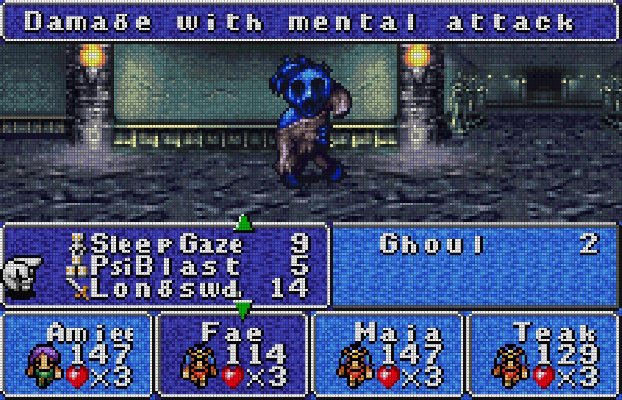
The fact that every attack is tied to a weapon or a spell – one with limited uses, one that takes up a precious inventory slot – trickles down to so many different resource-management considerations. Combat is often about minimising unnecessary durability loss as much as it is about clearing enemies as efficiently as possible, using cheaper weapons or dubiously-useful status spells, or spending stronger attacks with other party members, with hopes of preserving a good weapon just long enough until it can be replaced at the next town, or to get through the dungeon’s end-boss. Party members cannot attack without a useable weapon or spell, so you don’t want to get caught fighting a boss while being literally unable to act! And that’s just short-term preservation – there are enough incredibly strong but incredibly situational weapons that are worth considering sacrificing inventory slots long-term for; the durability-driven, very low inventory-space design is a perfect set of restrictions for introducing some comically powerful tools... but are they worth more than the resource strain in the here-and-now? Is it worth deciding you might as well do that later fight normally, when you so desperately need to slot in a status-healing item for the Stone-casters who made the last trip into the tower so frustrating? The truth is… maybe! The game dips in difficulty a bit after the first major section, and remains very, very low until a slow ramp up near the end; it starts to push back pretty hard by the end, but most of the game’s decision-making dynamics don’t really rear up until then – for much of the game, engaging with all its systems feels like a matter of making the game move quicker, as opposed to a feeling of difficulty or necessity. It’s the best set of RPG mechanics I’ve ever seen, in service of a fifth of one of the best RPGs I’ve ever played.
It’s hard to stay too disappointed about the frequent overly-easy (yet very quick and snappy) stretches of the game, though, when they’re being used in service of a world this fun! I’m in love with the playful subversions and reverent irreverence towards RPG tropes. Its structure is very straightforwardly typical – go to town, do a dungeon, solve a problem, go to next town – but the framing of it being multiple worlds leans into some pretty silly jokes: each sub-world branching out of the Tower is a different one-off gag, an early favourite of mine being the very first, where the NPCs sort of make fun of you for expecting there to be a town and shops there. And even though it’s a major part of the game’s aesthetic identity… I still laughed out loud when I picked up a handgun for the first time from a random chest. The ‘puzzles’ that gate progression are fairly light in this game, but even they’ve been given space to be funny, too! The old man’s riddle, the room full of orbs that subjects you to about fifty crab encounters if you missed the hint to solve it, the room where every floor tile looks like stairs… it feels like with the disjointed visual theming of the game world – a set of neatly segregated worlds with clashing, anachronistic motifs tied together by the thin connective tissue of the central dungeon – the lack of visual consistency allowed more confidence to make individual sections of the game a little more out there, as well. And the segregation of each world feels like a way to explore the typical town → quest → dungeon structure of the RPGs of the era through all sorts of different visual motifs and modes of play; not only do the worlds become increasingly ‘high-tech’ as they progress from typical fantasy worlds to high-tech and post-apocalyptic, but they also slowly transform in their structure: the early worlds holding more of a typical old-RPG exploratory structure, and the later ones being more linear and driven by their setpieces and sub-stories.
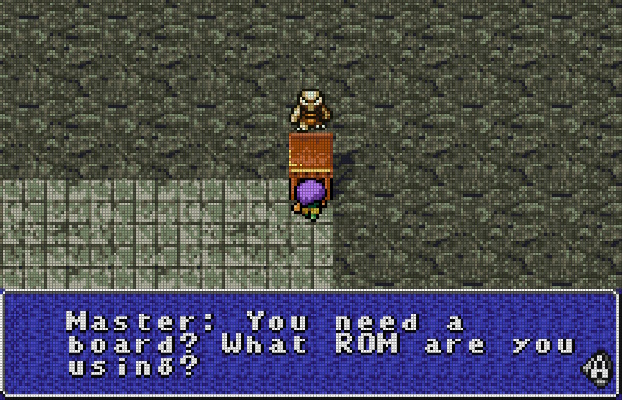
It’s interesting, though, isn’t it? Playing a version of a game that’s just noticeably different enough to make you question every uncertainty, but just similar enough to put said questions into question – is this a change, or not? How much of any of this analysis even applies to the original GB SaGa I – the one everyone’s much more likely to have played, the one you’re maybe even comparing your own knowledge and memory of with this piece’s analyses? There are enough clearly-identifiable differences on the surface – the graphics, music and toggleable run button of course create an entirely different mood, inventory space has been increased just a little, and the game provides far more information than the original was ever willing to. But more importantly than that… so much under the hood just feels so different, while lacking the transparency behind those systems to know if they actually are. What immediately stuck out to me, was that espers’ spell lists just felt off – different spells being learned at different times, some being ones I didn’t even remember being in the game – which ate away at me so much while playing that I started a new save of GB SaGa I just to see if my hunch was correct – and it turned out, with no way of knowing without this level of scrutiny, that WSC SaGa I had overhauled espers in their entirety! Directly useful, applicable spells become much less readily-available early on than in GB – which was handing out Barrier and direct-damage group-target spells fairly handily – in favour of status effects, awkward gimmicks, and very low-use instant death spells that make their ridiculous strength take a bit more effort to manage, and make rolling into a straightforwardly-good, high-use spell particularly special – and particularly exciting! Being the class that feels like it gives the game its identity, this, of course, heavily and yet completely silently changes the identity of the game – I’d spent the past nine hours playing Hiroyuki Miura’s Makai Toushi Sa・Ga Arrange Mode, and I hadn’t even known it.
I think there are a lot of reasonable, genuine reasons to be skeptical of video game remakes, particularly in the current day – so many of their changes being ones that flatten the original dynamics or balance of a game in pursuit of so-called ‘quality-of-life’, that feel as though they’re acting in service of seeking broader appeal and higher sales rather than feeling like interesting, well-considered changes to the foundation that the original game provides – and these often end up with said remakes being touted as an improvement, or even replacement, to the original. But it’s hard to be skeptical about remakes when all of their frustrations come down to execution rather than some immutable facet of their existence; and it’s hard to be truly averse to remakes when they aren’t the original piece, rather a reinterpretation, and a piece that’s directly reinterpreting another has no less inherent value than one that is not. I feel as though remakes deserve to be seen as nothing more or nothing less than a totally individual game, in existence alongside, not in place of, its source material. And although Makai Toushi Sa・Ga for the WonderSwan Color doesn’t always play into my own proclivities as much as the original, although there are aspects that genuinely are the same ‘quality-of-life’ balance changes I’m always so critical of, I can’t help but feel very, very fondly towards this weird little permutation of what’s now likely one of my favourite RPGs. It’s one that really does understand the original and what makes it tick, and makes a host of changes that play into that without feeling like it’s really trying to pull it apart – and I think I wouldn’t have enjoyed exploring it so much, were I not exploring a strange little remake of a game I’m already so fond of. And it's gotten me more interested in exploring more games like this, too.
~*ʚїɞ*~
Thanks for reading, as always. Talking about remakes is something I’m a little hesitant about – I don’t want to come off as if I’m having a ‘Take’ on ‘Discourse’ – but I hope my earnest optimism about the potential of them is something that comes through. I do still have a strong lean towards the original version of a game, at least if it’s my first time through, but… I’ve spent the past 3 or so years pretty ravenously playing everything and anything I can get my hands on, whereas my range in video games was incredibly limited before, say, 2022 – I wasn’t playing much aside from Pokémon games and MOBAs. But it’s been long enough since playing all these different games that a lot of the ones I got fond of are starting to ask for replays, and I’m starting to build deeper relationships for them… and I’ve felt like playing other versions of them – not just official remakes or alternate versions, but fan-works as well – would be a fun way to keep doing that. That was basically my impetus for both playing this specific version of SaGa I (well, that as well as wanting to dig a little deeper into the WonderSwan), and for wanting to write about the topic of remakes a little.
Also, this one just lets you play the original game as well! More of these should do that.
As usual, if you like what I do and you’d like an easier way to follow it, you can use the RSS feed to keep track of updates to the site itself. Love you all. See you next time. ~♡