faea gaming: May '26
Hello, again. I don't really have much of a preamble here... hope all of you have been doing good, and have had a good month.
Games I Played This Month
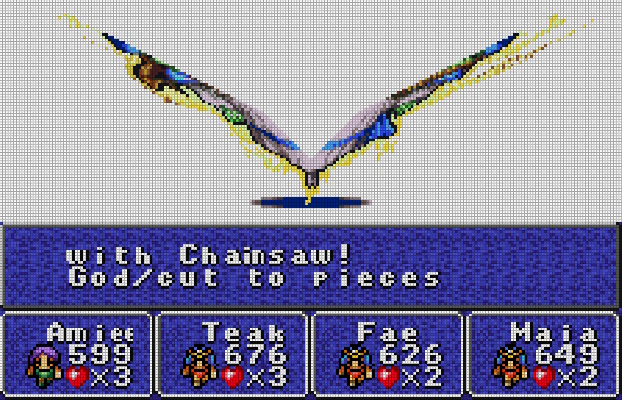
Makai Toushi Sa・Ga (WonderSwan Colour)
I wrote a piece about this one this month... so go read it if you haven't :p. I don't have a great deal extra to say about it, beyond that SaGa 1 is really great and this replay raiesd my appreciation of it a lot.. so I'll just post the outro blurb here because I think they touch on everything I'd want to say here anyway:
I do still have a strong lean towards the original version of a game, at least if it’s my first time through, but… I’ve spent the past 3 or so years pretty ravenously playing everything and anything I can get my hands on, whereas my range in video games was incredibly limited before, say, 2022 – I wasn’t playing much aside from Pokémon games and MOBAs. But it’s been long enough since playing all these different games that a lot of the ones I got fond of are starting to ask for replays, and I’m starting to build deeper relationships for them… and I’ve felt like playing other versions of them – not just official remakes or alternate versions, but fan-works as well – would be a fun way to keep doing that. That was basically my impetus for both playing this specific version of SaGa I (well, that as well as wanting to dig a little deeper into the WonderSwan), and for wanting to write about the topic of remakes a little.
Wild Guns
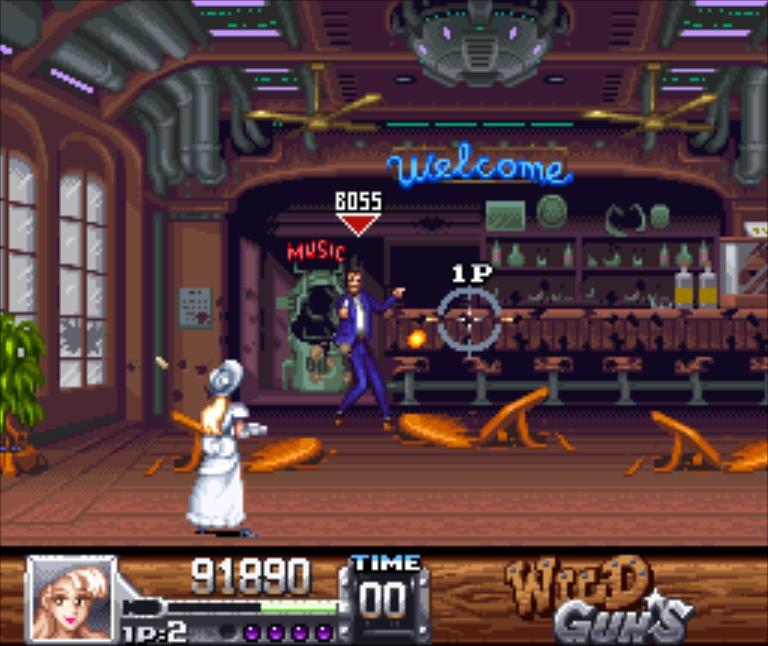
Seems pretty pedestrian at first blush: your defensive options in jumping and dodge-rolling are ridiculously generous, alongside being able to shoot enemy bullets to cancel them and a visual indicator on your character whenever they’re being targeted; game can feel like a call-and-response to a sort of excessive degree, being able to escape basically any situation on reaction. Only a few sections of the game let enemies pile up and permanently linger on the screen after spawning – most run away after firing their shots – so you aren’t often even punished particularly hard for stalling via defensive options. Not that you actively want to be stalling – each sub-level’s timer runs down faster for each enemy kill, and harder, more suffocating enemy waves rear up if you don’t end the timer quick enough – but it often feels too easy to escape any situation, so long as you’ve taken in what’s happening.
So it sort of opens up once you push past the base level and focus on its secondary systems. Scoring – which is significant for survival, as the extend threshold for scoring is fairly low – comes largely from chaining kills while never letting go of the fire button – effectively locking you out of any defensive option except for shooting enemy bullets and killing enemies before they can displace you. Smart, proactive reticle positioning and enemy prioritisation soar above the reactive dodge-roll and jump as the main defensive verbs and are far more interesting: killing enemies puts your reticle far away from your character across the screen, but cancelling enemy bullets (usually coming from the sides you’re not covering) tends to require pulling back the reticle towards your character to block a bullet mid-flight, so overextending too far to kill enemies quickly can mean being unable to cover enemies from another side, forcing out a jump or a roll which now feel like an explicit soft-failstate as using them instantly breaks the entire chain. And while performing any action other than shooting ends the chain, kills from bombs rack the chain back up immediately, meaning they can be used aggressively to build it back up after being displaced by a melee enemy or explosive.
There’s some fun nuance, against enemies with more bullets or big weapons, where aiming at the specific part of their body where their bullets spawn will cancel their shots before they even appear – usually being at the cost of damage, since these spawns are oftentimes detached from enemies’ actual hurtboxes. And shooting down enemy bullets increases a ‘super’ meter which, upon filling, rewards the temporary ‘V-Gun’ superweapon. While this sounds completely harmonious with the score-focused playstyle – shooting down bullets becomes the main defensive option; shooting down bullets fills the bar that makes you stronger – there’s oftentimes a good level of abrasiveness between the two. The super bar fills very slowly, and the gun both lasts a very short time and does not persist between sub-level transitions, so it’s ideal to manage the meter to have it activate in difficult sections – this can lead to either delaying kills on enemies to let them fire their bullets, or intentionally not cancelling bullets if the meter is too high, and letting the chain drop if one gets fired!
Though I think these Natsume action games are great ‘intro-1CC’ games, since they start off very daunting and flatten out to manageable and almost calm once you get into it, the execution precision of this one is making it much more of an ordeal than Pocky & Rocky was… but I got a 2P 1CC with my friembd :) :) :)
Wild Guns: Reloaded
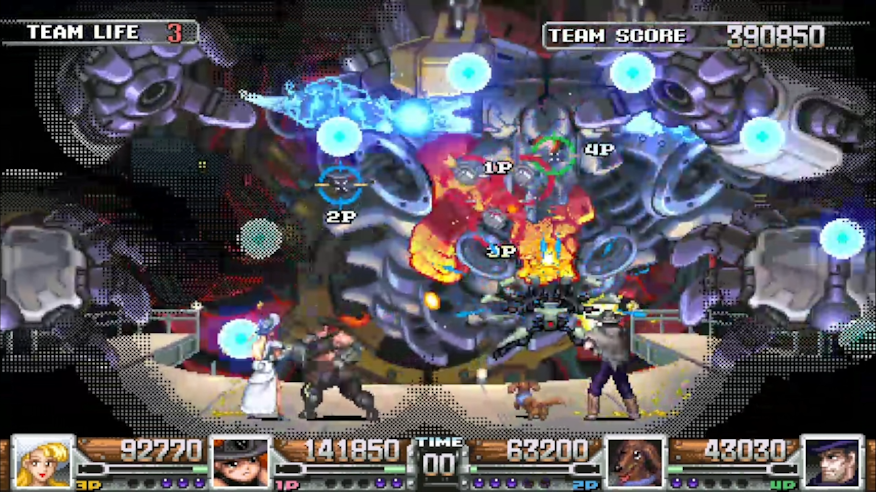
I’m gonna be honest here – I think this is the first time I've seen a ‘modernisation’ make the core of a good game even better. I’m talking about the widescreen here! A much wider space for enemies to appear means having to make much more committal reticle movements to cover them and, frankly, just makes it far more challenging to focus attention properly to read the complete picture of what’s happening on screen. Occasionally it does feel like Wild Guns But Wider!, particularly in the bossfights which are just as linear (and quite frankly, not very interesting) as in SNES, but some stages lean into widescreen’s room for extra density and chaos really well – Desolation Canyon is a particular standout here with the ‘zombie’ gunners spawning mid-screen across the whole level rather than having to run in from the side of the screen, making it a much harder map to manage than it was before.
This one also doesn’t have the somewhat noxious fullscreen-flashing that SNES does, so that’s nice.
That’s not really any of why I like this one more than SNES though – they really knocked it out of the park with scoring in this one! Added are a couple of new nuances to scoring: lassos don’t break a chain, so it’s easier to stand ground and enemy prio can be a bit different; and more significantly, hidden moneybags in stages can be revealed, then need to be shot multiple times, multiple times in order to break them, then the cash needs to be shot individually for 1000 score a piece – totally distracting attention from everything else happening on the screen. But more importantly is one of the new characters, Doris – as well as being one of the most beautiful women ever put to paper, her mechanics and scoring work entirely differently to the two standard characters: her standard fire throws grenades, and holding the fire button charges up to seven grenades, with each enemy killed by the blast giving a score multiplier per the amount of bombs charged. Killing with the full 7 grants a 7x bonus, which is higher than the standard chain system allows! So rather than long-term chaining, her scoring is focused on optimising as many individual, high-scoring grenade kills as possible. This works so elegantly when put next to the standard characters, as they both have completely contrasting goals and strengths – Clint and Annie score by standing still and shooting non-stop, being able to score well in stages through outputting constant offense, but lacking the ability to deal with explosives or melee enemies, or score well against bosses. Doris’ scoring requires her to leave herself completely defenseless for seconds at a time while charging grenades, but doesn’t need to build up chains long-term over the course of the stage, and doesn’t lose access to her dodge-roll while charging. Routing scoring in 2P with Annie and Doris is almost kind of beautiful, trying to take advantage of both characters’ inherent strengths while covering each other’s weaknesses, but without stepping on each other’s toes too much and stealing strong score opportunities from your partner.
Don't ask me about the dog.
We also 1CCed this one while trying to route out score :) :) I think this is one I’d genuinely love to push for really good scoring in over the long term, they really made a special little thing here.
The Legend of Zelda
I’m keeping it short, because I’d like to elaborate on this one in future, but… this game is really, really good. Put aside what you might’ve heard about this game’s cryptic, secret-hunting, bomb-spamming nature – it’s got a very straightforward, clear and consistent design language for the vast majority of its puzzles, and most of the NPC hints, while obfuscated by intentionally and unintentionally-awkward and vague delivery, do tend to tell you exactly what to do once you cut through their layer of obfuscation. It’s not easy, to be fair – and I did start to stumble a bit near the end, both from not noting down hints diligently and from the later puzzles starting to break away from said consistency to elevate on their difficulty and complexity – but… I didn’t draw a map, I didn’t note down any hints, and though I leant on my friend a couple of times who was doing all of those… I earnestly believe this game is totally fine to move through without an excessive amount of external effort. And what’s here is pretty brilliant: a game whose structure leads to almost a full level of open-endedness, in how dungeons can not only be tackled in almost any order, but don’t even need to be cleared to earn their major upgrade; and whose dungeon-crawling and combat get, frankly, really, really good by the end. Combat is great from the beginning, thanks to the precise 4-directional rigidity of movement and attacking, and some very sharply-written enemy AI that follows predictable broader patterns while retaining a level of unpredictability that encourages cautious offense and mandates some really tight footsies in enemy-dense rooms. Darknuts and Blue Wizzrobes stand out as the clearest most interesting enemies in the game with how their unique attributes force an extra level of consideration towards moving around them safely. They interact well with other enemies… but they also just interact well with themselves – a room of six Darknuts elevates itself so much more interestingly than so many meticulously-crafted enemy-layering challenges; not sure how they managed that. And while the dungeon layouts themselves usually feel a vessel for some fairly basic navigational challenges… Level 9 is really good. That’s a really competent microcosmic Wizardry dungeon right there. I spent upwards of four hours watching my friend stumble through it after I’d finished the game myself and it really cemented that that’s probably one of the coolest things put to paper in a Nintendo game.
Isn't it so fuckin funny that Ganon looks like the Devil from Devil World
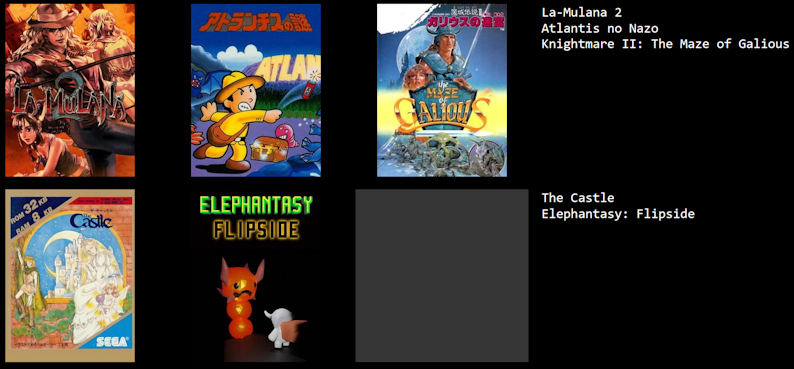
You know, though? I went into this game somewhat expecting a much more difficult exploration and information game – my friend and I were expecting to be doing a lot of collaboration and information-swapping that didn’t really happen – and while I’m not particularly beat up about this game not being something it isn’t, it’s got me kind of fiending for something that really is Like That. But I don’t know many of those! So this is an open call to everybody reading this to suggest me… anything that ranges from ‘a little bit more involved than Zelda 1’ to ‘the sort of games that Miyamoto would call “grotesque hidden secrets” games’. I don't know much about any of these, so I don't know if they're a bit off the mark, but these are what I have noted down at the moment…:
Super Spacefortress Macross II
Really interesting take on a caravan-style shmup: 2-min long stages with infinite lives, but fail to meet the stage’s score threshold by the end of the timer and instantly game over. It’s basically forced score-routing for a survival clear, and I really appreciate that! Being a caravan game means it’s primarily a game about speedkilling enemies, but a large focus of its scoring also revolves around item collection – from enemy drops, and from static placements on the stage – which try to push you out of your speedkilling positioning and make you let enemies leak and slow down the pace of the stage. Score thresholds get really tight in the later stages which, alongside hidden items and score bonuses being so significant, gives it a liiittle bit of a strong memorisation-y feel, but the execution is tight enough to where I don’t really mind. Memorisation feels like a very big pain point in shmups, and my own take on it is simply that: if the execution is still fun after the game’s been learned, it’s alright in my books. I like Pocky & Rocky, after all :p.
Radirgy
A particular formative memory for me circa 2020 was reading a developer comment on the music direction for their difficult game being as such to keep people calm whilst dying tens or hundreds of times on a single level, and though it’s certainly not unique to the game in question, it’s the first time it was ever directly brought into my focus, so it’s been a memory I keep rolling back to whilst playing arcade games. Shoot ‘em ups in particular, especially those of the ‘90s onwards, feel like they’re gunning for a healthy dose of bombast and audiovisual overload, trying to be the loudest, flashiest and coolest cabinets compared to whatever they’ve been put next to; the trouble is that the game’s mood tends to project a bit too hard onto my own mood, so games like that tend to get my emotions far too high during a really tense part of the run! So though it isn’t totally my thing stylistically, I still really appreciate Radirgy’s calmer, more low-key aesthetic direction, primarily for keeping my own self calm, but it’s also a fairly unique style for games in general and the music got rooted really deeply into my head after just a few plays… I’m humming the Stage 1 theme without realising, because I’m spending most of my playtime on Stage 1 :p.
Game’s got light caravan mechanics, which naturally implies it’s a score-focused game… and frankly I could not imagine playing this another way. Scoring is multiplier-driven, with multiplier earned by cancelling bullets with ABSNet – a meter-driven invincibility and bullet-cancelling field – or cancelling bullets with your shield (increased with ABS active), which only appears if not attacking. The ABS meter, in turn, is built by killing enemies, particularly with the sword, which combined with caravan-style spawning enemy waves encourages quick-killing said waves as aggressively as possible, to both recharge and chain ABS and to get as much value out of a max multiplier as possible. The catch is… these two systems often contradict each other! Building multiplier, especially in the early stages, often means stopping shooting and sitting on top of big enemies or waves with shield and ABS active, while refilling ABS and actually benefitting from all that multiplier involves killing everything while putting the shield away and watching that x16 multiplier drop like a sack of bricks. Routing and executing score-play then becomes a very tight balance of managing these two systems – leaving enemies alive to use for mult gain, and killing them for score and ABS gain – and pushing one too high over the other, even for a matter of milliseconds, can leave either the multiplier meter or the ABS gauge dropping just too low and cause everything to start spiralling out of control.
Dig a little deeper and you’ll see even more nuance pouring out of the most innocuous places. Score item drops can be juggled by the sword, and hitting them enough times will transform them into a different item TwinBee-style – usually a larger score item, but sometimes a directly beneficial powerup: a multiplier-increasing pickup is straightforward enough, but a full ABS refill encourages juggling it around until your own meter is full so you can pick it straight up for an instant refill – while trying not to let it transform back!, and the bullet converter transforms all bullets on-screen into small point items, which is comically lucrative by itself as score items are affected by the multiplier, but with a bit of luck… those point items can be juggled into other powerup spawns, perhaps even another bullet converter. And the grounded score items dropped by the few static enemy spawns in the game uniquely do not benefit from the multiplier, but instead algorithmically increase in value based on how many have been picked up during a play. And they’re really hard to pick up while managing the three other highly focus-demanding scoring demands and not dying at the same time, but the ABS auto-collects all items after it expires, including these… giving an extra layer to ABS use that’s still fighting for priority against all its other applications.
I can’t lie, though, this has been a nasty game for me to survive in – the scoring playstyle demands extremely aggressive play and zipping around the screen as much as possible… but enemies appear from all angles, firing floods of bullets that, by nature of the caravan spawning system, do not form directly-curated challenges and instead flood the screen with noise intended to be cancelled with the sword, shield or ABS… many of them needing to be cancelled in different ways*, and most of those bullets looking near-identical at a glance – almost every bullet in the game is orange, and the two most common types only differentiate by a slight difference in the colour and detailing! I’ve probably said the words “sensory processing disabilities” a little too much in these notes over the months, but… this sucks! For me, and probably a lot of other people too!
~*ʚїɞ*~
Thank you for reading, as always. There's a few other games I've sunk a bit of time into that I haven't formed strong enough thoughts to talk about just yet.. Kirby's Dream Land 3, Faxanadu, Ninjawarriors Again and Once Again, and Doom II. I'm fairly close to the end of all of them, so they'll probably show up next month, but my short opinions on them...: I think DL3 is okay (kinda neg), I think Faxanadu is okay (high praise), I think Ninjawarriors Again is probably extremely good, I think Once Again is a little worse thanks to widescreen but makes up for it with the silliest gimmick characters ever put to paper, and I think Doom II is really great (kinda neg, because it's too hard for me :p ). It's also... starting to get pretty hot over here now, which I've noticed in recent years kind of puts me in a bullet hell mood, of all things, so maybe I'll start idly playing some of those. I'm not too familiar with capital-B Bullet Hells beyond Touhou and the more 'canon' CAVE entries, so... you should tell me what your favourite bullet hells are, and I might play them. You should also tell me what your favourite "grotesque hidden secrets" games are as well, don't forget that.
You should also... not forget to read my piece on SaGa I, if you haven't already :p. Anyway, thanks again for reading. See you next month. ~♡