Galaga '88
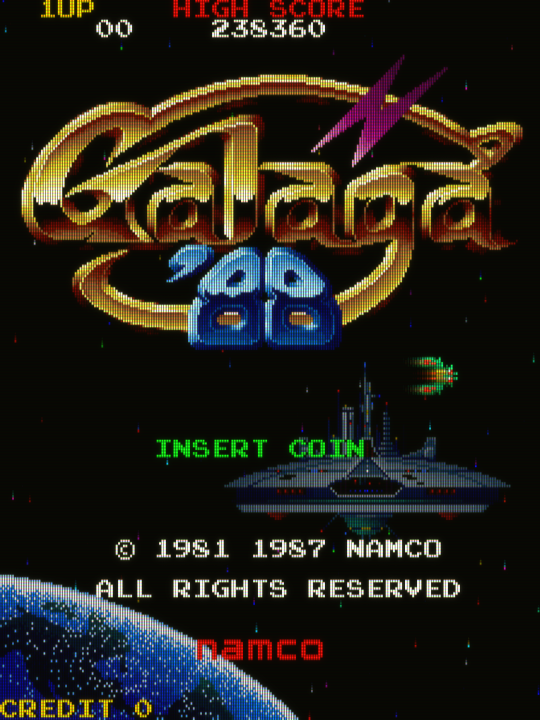
Sometimes a game reminds of how infinitely far simplicity can be pushed, the M.O. of so many old, seminal arcade games. The core of Galaga – one both beheld by the same approach but advanced in both technology and iteration to push its Space Invaders-derived fixed shooter core forwards so heavily – is perfectly visible here. Enemies enter from the sides of the screen, encouraging moving close to quick-kill them while putting yourself much closer to the source of danger, then retreat to the top where each evemy type adopts unique movement behaviours, not only pressuring through bullet fire but how their movements control the space around you, many dipping under and around the player ship to restrict its movement if not killed quick enough. The highlight, of course, being the Boss Galagas who swoop down to restrict an entire section of the screen with their tractor beams, colliding with which captures the ship rather than destroying it; the ship can be recovered by killing the same Boss mid-flight and attaches to the side of the new ship, effectively spending the lost life to upgrade the ship with twice as many shots and extra coverage, but at the cost of being twice as wide and easier to hit. This creates a push-and-pull dynamic where, though the double ship is much more powerful and ideal to keep for as long as possible, taking a hit and being sent back to the single ship means playing as a less powerful but much smaller and more evasive ship that’s ideal to simply survive with until the next opportunity for a capture and recovery.
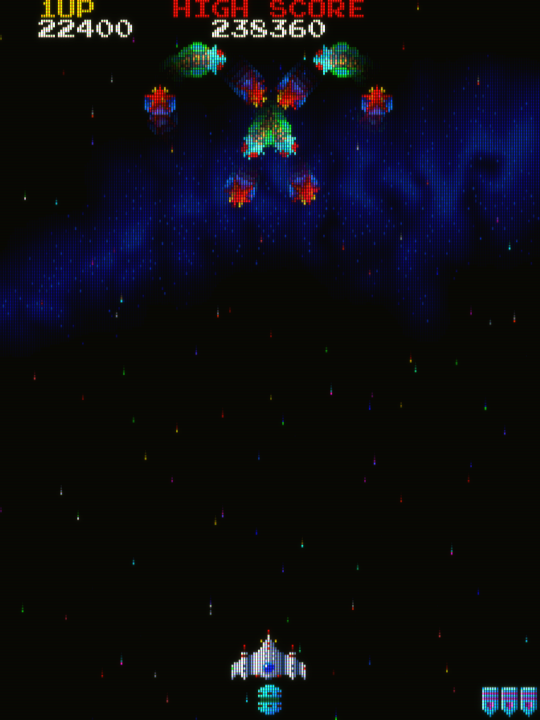
The model of elegance through simplicity is hard to apply to Galaga ‘88 on the surface, though, because they shovelled a million new ideas into this one. Yet rather than feeling loose and directionless, they all play into the simple core of Galaga and build on it intelligently: new enemies with new behaviours, now forcing even more specific movements through their own threat ranges, movement patterns and specific gimmicks, the latter further demanding risky play for a point bonus if killed properly – the earlygame’s coloured ‘balloon’ enemies, for instance, sometimes drop falling targets in specific patterns when killed that give a fairly large score bonus if all their debris is rushed towards to clear before falling off the screen; the danger not coming from the position of the debris patterns themselves, but the risk of moving towards them to clear them out in the midst of enemy fire. The majority of these new enemy types are accessed via a Dimension Warp: collecting two energy tanks – either from static stage hazards or an uncommon enemy type that only spawns under specific manipulable conditions – before a challenging stage causes a warp to the next dimension, with each dimension having the same stages but populated by a different set of enemies and hazards. The implementation of this acts as a controllable difficulty modifier: it’s possible to intentionally avoid all the energy tanks thrown at you to keep the difficulty as low as possible for a much calmer survival-focused play – though this comes at the expense of not seeing the majority of the game’s enemies and challenges, which can be seen only by pushing that difficulty – and by extension, scoring – higher and higher. And lastly, recapturing a double ship upgrades it into an even stronger ship with faster, wider-range and more precise shots, at the cost of both an extra life to get there – very often leaving you on your last life – and the higher stakes of effectively being downgraded from the double ship to the single during the recapture process on top of that.
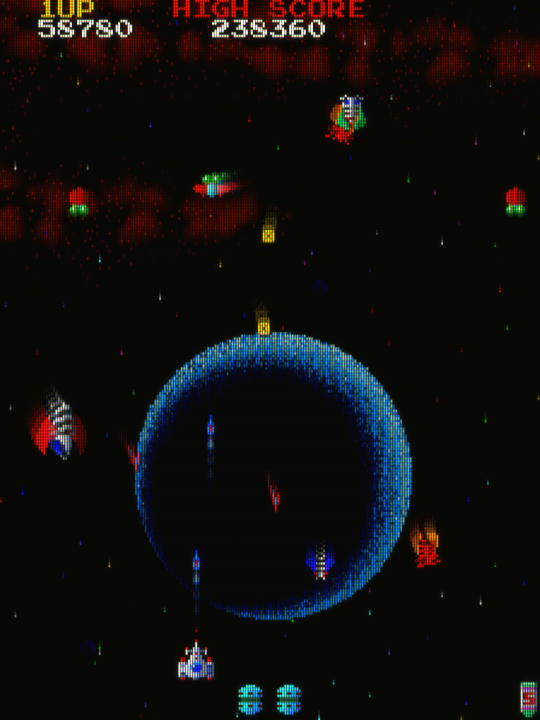
All of these ideas feed into an expanding web of decision-making and spatial awareness demands that layers tall on top of what the original Galaga lays out: managing enemy prioritisation, both targeting the most difficult enemies first whilst potentially trying not to kill certain enemies too quickly in order to benefit from them later; doing so while dodging through bullets and numerous different overlapping threat ranges, and all while fighting to stay away from the edges of the screen. Can I rush to take this enemy out, or am I likely to pin myself in the corner or ram into another enemy sweeping below me? Is it worth moving to the sides to kill these tricky enemies sooner, or stay in the middle and have more space to take everything as it comes? How will certain enemy types react when I shoot them; is it safer to ignore certain enemies for the time being so I don't risk making them more dangerous? These are further compounded by the ‘recovery phase’ of needing to recapture a ship in order to upgrade: if I try to initiate the recapture early, the enemy and bullet density might be too high for me to feel comfortable holding out as the single ship if I’m on my last life, but waiting too long might cause the Boss Galagas to stop using their tractor beams and deny the recapture attempt until the next stage. Or I might be walled in against the side of the screen by a tractor beam, in which case is it safer to try to dodge through the enemies in that tiny enclosed space or initiate the recapture now?
Shoot-’em-ups are hard! They’re intense! And this one’s no different, so it’s impressive that it ends up being so calming, so relaxing. Aside from the introductory jingle and the short musical numbers that accompany the challenging stages, the soundscape is purely comprised of sound effects: the melodic pops and bursts and whizzes of ship fire and enemy activity, backed by the dim and gentle glow of nebulae reflecting their ever-changing hues onto satellites and asteroids with gentle drops of multicoloured raindrops dancing in lead; it’s constant, full-focus action that rewards a relaxing set of background sounds playing out in the exact rhythm of your actions. Challenging stages are transformed into miniature dance routines acted out by formations of enemies, a break amidst the intensity rather than a continuation of. The system’s heightened graphical power is used to convert the abstraction of its early arcade predecessors not into further bombast and excess, but into something something much lighter; a presentational pulse that lowers the game's intensity to something gentle and charming; something to cut straight through the game’s difficulty and keep tension low. That calmness making it much easier to replay over and over compared to the myriad high-octane, energetic shoot ‘em ups that surround it, whose adrenaline rushes struggle to get more than one play out of me at a time. So why not stop shooting for a moment, let the enemies finish their dance, and take in the sights and the sounds they’ve made just for you?
~*ʚїɞ*~
Thank you for reading, as always. I’ve only been playing (non-Touhou) shmups for a couple of months, and this game even less, so I feel a little unqualified talking about a game that wants long-term mastery with only a relatively modest set of survival-focused PBs after a couple of weeks of play. I can’t even talk about scoring! I’m being told that keeping the single ship is optimal for scoring, which flips a lot of what I’ve talked about completely on its head, but I don’t have the experience to discuss that. But as I’ve gotten further into arcade games I’ve been re-examining my relationship with shmups in particular, and building a deeper understanding of which types I like and which I don’t, and I’ve learned that I’ve found fixed shooters some of the most fun… this game being my favourite of them, and basically shooting up to be an instant favourite, so I wanted to give it some words and some visibility anyway. (the above also means I don’t really like shmups with names like DoDonPachi DaiOuJou or Battle Garegga… sorry shmupheads.) I’ll be good at these one day… maybe!
I said in last month’s journal entry, but this is the last entry that’s going to be posted on my Substack, with the rationale that I want to be as little reliant as possible on external services. Cutting down on those also cuts down the reach of these posts an awful lot, so I’d very much appreciate sharing these posts around if you find them interesting! Right now, the reach of my posts is entirely reliant on word of mouth. Without the regular newsletter updates, you can use the site’s RSS feed to keep track of updates to the site instead, or just check back once a month :p. Love you all. See you next time. ~♡