Finding Artistic Inspiration in Touhou's Early Days
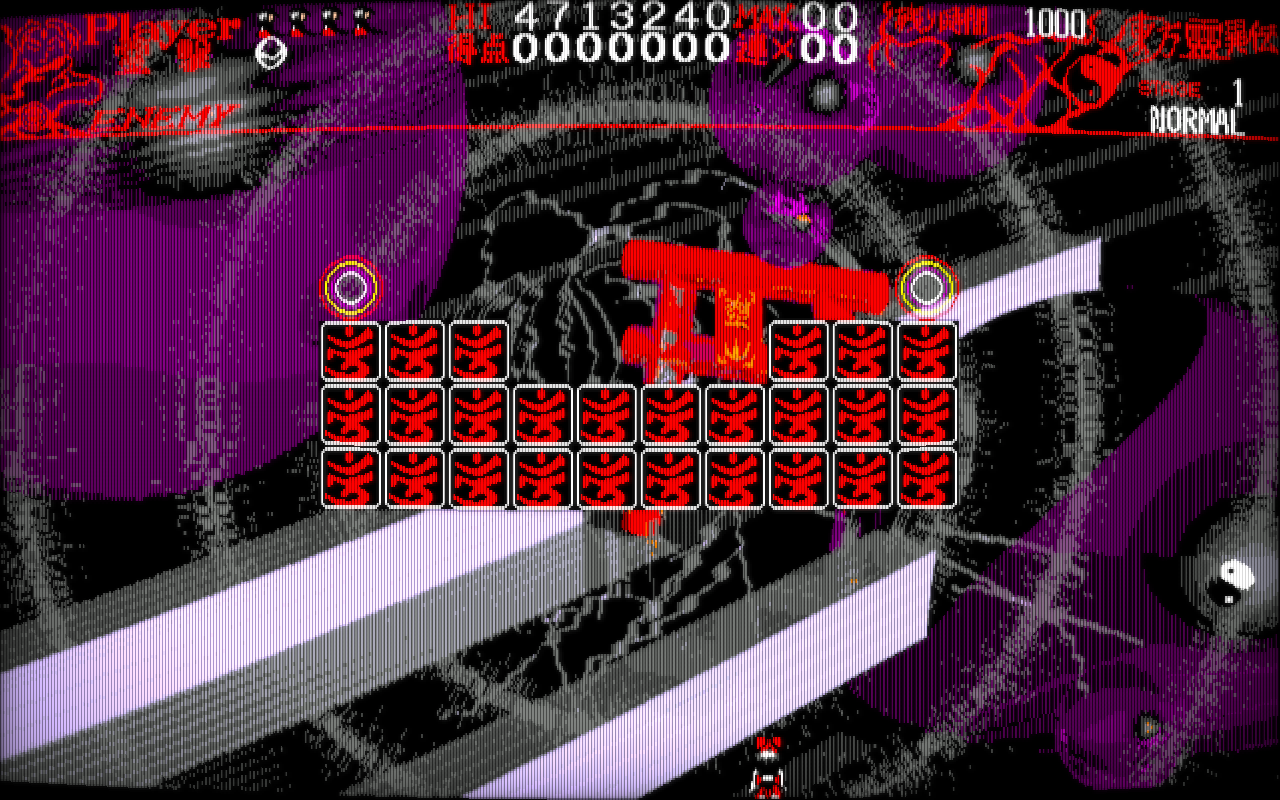
The easiest word to describe the first Touhou game, the Highly Responsive to Prayers, would probably be ‘awkward’; it’s a patchwork of aesthetic and design ideas that feel propelled by an overly-confident and inexperienced, almost naïve level of ambition, such that all its elements often feel like they’re crashing against each other. It’s a very creative iteration on a Breakout-styled game, controlling a character who has to manually hit and shoot the ball with a fairly large moveset, whilst avoiding contact with enemy bullets and the ball itself – none of which feel particularly compelling at first blush: many of the moves feel extraneous and unnecessary next to the core of sliding and shooting, and certain (important!) moves send the ball at wildly inconsistent speeds and angles, making ball control often feel like an ordeal even with a good grasp on how to wrangle it – the hardest challenge while learning is just to hit the ball into that one last tile at the top of the screen. And its stages are represented only by backgrounds composed of heavily compressed and harshly-dithered abstract images, of which the high colour detail, when layered behind detailed sprites, blows past the colour limit of its hardware and forces other sprites to recolour to adhere to them – most notably the player character herself and her projectiles.
But it’s that aesthetic that struck me the most initially – the stage backgrounds are often very beautiful and striking, and their abstract nature – the strangeness of the images themselves, and their lack of in-game contextualisation – backed by a soundtrack comprised of largely very delicate melodies sung by sharp, low-quality instruments, gives the scenario a pervasive feeling of unreality; the abstract, almost solemn-feeling mood that punctuates the play itself twigs my imagination more than anything has of late, drawing it to conjure a world to this game where nothing feels as though it quite makes sense, one that might not even be real at all. Sinking myself into it for longer and longer helped the challenge of the ball control grow on me, as well; it’s absolutely an uphill battle to wrestle something so unpredictable, but figuring out useful details about the moves as well as specific strategies to control the ball in certain situations makes it much easier to handle, and then extremely satisfying when everything works out – it’s a wonderful feeling to juggle it long enough to build up large score combos, and to be able to consistently nail those last tiles that used to give so much grief. And even the wildly-overcentralising bomb system is something I ended up appreciating! It’s absolutely unbalanced to have a system where losing a life rewards an extra bomb and bombing at the right time can earn more than one extra life, but it leads to strange resource-management dynamics where capping out on either lives or bombs can be suboptimal, as spending one will almost guarantee gaining the other, and encourages spending resources in otherwise-unusual ways to balance both out and avoid losing resources from overcapping.
the Highly Responsive to Prayers is so, so clearly an amateur work – it’s literally, visibly coming apart at the seams at times – but ‘amateur’ isn’t, and shouldn’t be taken as, synonymous with a lack of quality. To me, as someone who’s also scraped together solo passion-project video games with a limited skillset, blu-tack, hopes and dreams, seeing the cracks is part of the appeal, but seeing the naïve overambition of my own projects reflected back at me in a game still this well-realised is downright inspiring. The backgrounds wouldn’t captivate me so much if they didn’t feel like a set of images taken from elsewhere and collaged into the game; the cute pencilled drawings of all the bosses on your route wouldn’t hit me so hard if not contrasted visually against the game’s poorly-considered colour palettes constantly contorting and smashing against the hardware that can’t properly handle them. It’s a game where passion and inexperience both are tearing against the limits of what they were actually capable of making, the areas they were clearly extremely good at awkwardly balancing against the weight of those they weren’t, and seeing a game shine so bright with all its fumbles and warts on display makes me think that maybe, just maybe, my own inexperience-driven projects can reach the same heights, too. These works, more than anything, make me want to keep making.
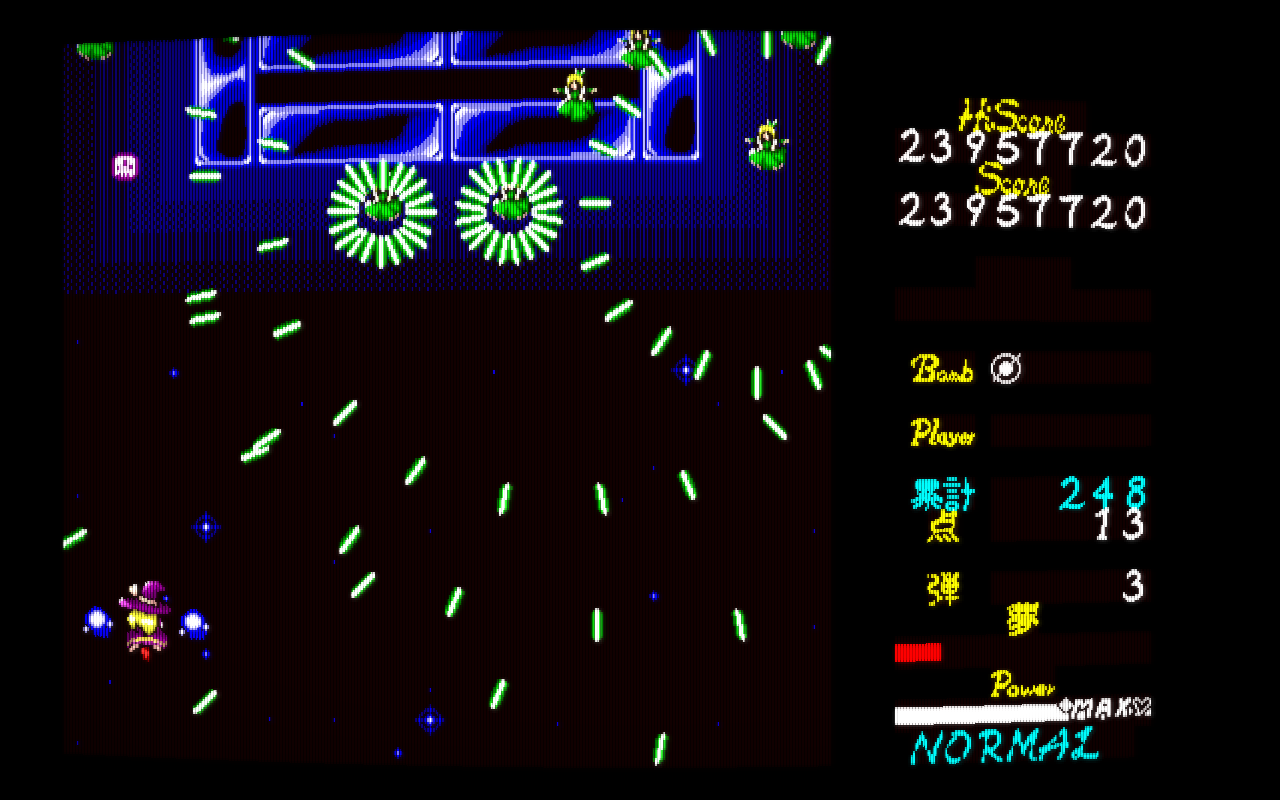
Mystic Square, in turn, exists in almost complete opposition to the Highly Responsive to Prayers, feeling immediately far more mature in the design of both its audiovisuals and gameplay. Even next to the multitude of future Touhou games and other shmups under my belt, I’m really appreciating the design sharpness here; it’s is mainly noticeable through the bossfights, with most of the later encounters involving multiple separate elements to keep track of that weave a welcome level of controlled chaos into their fights. My favourite showing is Stage 4’s duo bossses who swap between interacting with each other’s patterns and firing two lighter, completely independent ones at the same time, with the latter being very easy to get pinned in really uncomfortable positions by without very confident reading and pre-positioning. Boss patterns as a whole also tend to overlap with each other, the next coming out before the last one moves offscreen, making it very easy for bottom-hugging to result in getting pinned between two and encouraging playing a little further up on the screen to move up through the bullets before the next wave comes. They generally feel like they push against more valuable skills than at least the easier Windows Touhou games do: those games often have very intricate patterns that feel very slow and reactive, often not demanding much more than reading slightly ahead and wiggling through everything; while these have much simpler individual sections that expect noticeably more proactive play.
But it’s the confidence, the energy, the spectacle, that I love this one for, more than any specifics of the gameplay. Utterly unbelievable audiovisual bombast here; it’s the work of an artist who’s found their voice and knows it. From the first second, this game feels celebratory: the upbeat, encouraging melodies firing off as you tear through enemies that haven’t even learned how to fight back yet, into stages that are some of the series’ biggest and most creative choreographic feasts even compared to the Touhous of today; soaring through meteor showers and culminating in two stages of a literal fireworks display. Knowing that this would be the last PC-98 Touhou game before a four-year dormancy makes it feel like a very conscious ‘last hurrah’ for this era of the series, or perhaps even the series as a whole, if things worked out differently – putting absolutely everything into this final blaze of glory before taking a step away, a celebration of all the artist’s personal growth thus far. It’s just as encouraging to me artistically as the Highly Responsive to Prayers’s underdog scrappiness is, to see what that rough little game’s creator would ultimately blossom into into in just three years! And if dodging through a fireworks display isn’t celebratory, then what is?
Both games are wonderful in their own right, but what's made the pair so infatuating is seeing them as both ends of a stage of a single artist's personal growth – beginning with the Highly Responsive to Prayers, a very unusual, scrappy and jagged, yet confident outing so clearly full of its creator’s love and passion; and ending with Mystic Square, an incredibly polished and well-constructed shmup whose aesthetic direction feels almost self-celebratory, an artist’s expression of pride of what they’d managed to achieve. Playing once again through this journey of growth, moving from a game with rough edges and clear overambitions that feel not dissimilar to my own projects, to one so beautiful and well-realised, yet still not feeling out of reach, has been deeply inspiring to me – not in the typical way, where I draw inspiration for specific ideas, but in the very rare way where it inspires me on a personal level, inspires me to keep on creating. Maybe my own projects I see as rough and awkward, where all the ugliest aspects are so clearly visibly to me, can be stronger than I can see. And maybe my works can flourish into something I’m deeply proud of, like these did.
~*ʚїɞ*~
Thank you for reading, as always. I think I’ve enjoyed putting out a less analytical, slightly more personal piece; I think I’d like to keep injecting ‘me’ into these pieces a little bit more. I’m intentionally trying to broaden the topics I talk about when I pen a bigger piece like this, since most of my pure analytical work ends up in my (admittedly rather rough and casual) faea gaming notes, and I rarely find I have enough extra to say on any to transfer them from notes to a larger piece. I have a few ideas for what I’d like to tackle in the coming months, some similarly personal and some fun and casual… I think it’s going to be fun.
As usual, if you like what I do and you’d like an easier way to follow it, you can subscribe to my Substack and get these beamed directly to your email box – it’s free and always will be; or you can use the RSS feed to keep track of updates to the site itself. And wish me luck for my ongoing Mystic Square Extra Stage grind. Love you all. See you next time. ~♡