faea gaming: January '26
Hello, everyone. It’s felt like an eternally long month, hasn’t it? This month, I've spent more time than any playing arcade-style games. It’s a really nice feeling to become really, really proficient at something over a long period of time, and it’s also becoming more and more appealing to my increasingly-distractible and non-committal self to be able to get a very ‘full’-feeling session in even as little as ten minutes. It’s been hard to get myself to play anything else recently; maybe it’s becoming a problem... Anywayyy let’s talk about some of them
Games I Played This Month
Wizardry Gaiden III: Scripture of the Dark
I may have enjoyed others more, but this is, if I can be honest, the most inspired I’ve ever felt by an RPG. When I was drafting my own RPG, the thing I struggled most with was level design – most games I’d played at that point used dungeons solely as a vessel for random encounters, which is a dynamic I enjoy a lot, though outside of a few tricks (light puzzles / mazes) to squeeze more potential encounters out of a particular space, it’s hard to think of any particulars that make these dungeons ‘good’; if you asked me to pick my favourite one, I’d tell you I can’t remember anything about any of them. These games, on the other hand, are the dungeon; combat and attrition is still present, but equally if not less demanding than solving the dungeon itself. Sprawling labyrinths that vastly outstretch your extremely limited field of view and beg you to map them out manually, navigational challenges that test your cartography and spatial awareness to an extreme, and puzzles that feel a little more involved and tend to demand scouring every last tile of the dungeon. Giving the dungeon its own dimension of challenge, completely detached from combat, lets it feel like more than a means to some other end, allows it a real presence and personality.
I loved Gaiden I for a lot of reasons but still felt its dungeon wasn’t that exciting; most puzzles being fairly straightforward and layouts and navigation being quite simple meant that the vast majority of the game’s challenge still came from that ‘JRPG’-esque attrition, just with a Wizardry coat of paint. This one gets it, though!!! Immediately the game shows its hand by dropping you into an entire navigable gameworld – a dungeon full of dungeons – as opposed to I’s more traditional seas of grey brick walls; immediately it expects you to take note of the scenery, even cross-reference different maps to make its puzzle go by a little faster. A particular favourite moment so far was a particular dungeon whose crossroads spin you in a random direction whenever you enter them, with most of them looking identical at all four exists. It forces you to spend a limited use of the map spell to know which way you’re facing rather than using it to aid navigation more traditionally, and by extension punishing sloppy mapping and reliance on that spell to navigate – my biggest problem with Gaiden I being that the map spell’s automap was too easy to rely on.
Kind of dropped off halfway through in favour of my stupid little action arcade games, but I am soo hungry to tear at this one again once I’ve regained my RPG drive
Touhou Rei’iden ~ the Highly Responsive to Prayers
(faea postnote: hi. hello. hope you're good. i typed this up at the start of the month, then ended up cleaning both this and the below mystic square entries and congealing them into a more proper writeup. i’m leaving both these entries here as-is, but definitely read that as well. ok byeeee byebyebye)
(plays makai route) someone gotta tell this ZUN guy that putting dark blue lasers on a dark blue background is probably not a good idea
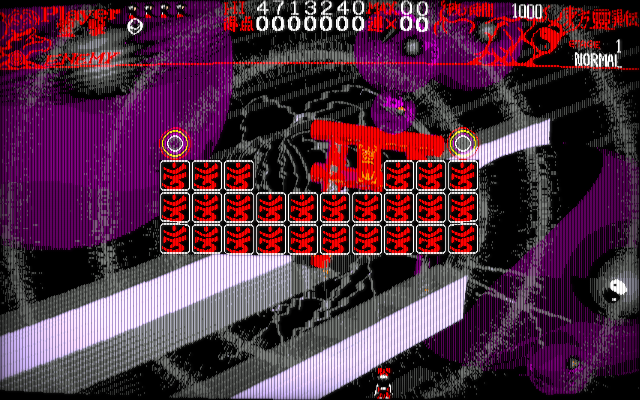
Rather than its gameplay, what I find most immediately striking about this game is its presentation: the slightly crunchy music and incredibly crunchy heavily pixellated backgrounds, dithered to almost destruction; the mood of hearing Eternal Shrine Maiden playing whilst trapped in the exploding purple hell dimension is one that my first response is to describe as “purgatorial”. Though I can’t write off the gameplay either, despite it certainly being something of a hill to climb – all of my early attempts to get into this were locked down by the almost Sisyphean-feeling task of simply having to knock the orb into a single tile in the top middle of the screen – but getting used to the Breakout-shmup moveset and gaining somewhat-consistent control over the wildly inconsistent orb is incredibly fun; being able to hit that single tile on the first try is unbelievably satisfying. The bosses are…. weird; it’s a lot of fun managing boss patterns while positioning to hit the orb properly – threading under a bullet spread to land a perfectly-placed slide is the most satisfying thing ever, probably – but their attacks mostly rely on white bullets which can be quickly and easily deflected, and anything else tends to have so much speed and coverage that you aren’t dodging through bullets so much as getting as fast as possible out of the way, or bombing. And bombing is the silliest dynamic in this game: scoring is achieved by building a ‘combo’ tiles without letting the ball hit the ground, but bombing – which hits every tile on the screen – adheres to this combo system.. so you can gain one or more lives from a single bomb. And losing a life adds a bomb to the stock, so it gets silly really, really fast. It’s a very comical resource-management-y dynamic – intentionally dying to shift lives into bombs and make space for more extends feels like a genuine strategy for survival – but maybe a bit too much so, since you can make about a hundred serious mistakes in a run and still pile lives back on with decent ball control and a lot of bombs; maybe I should be playing this one on Lunatic instead :p
the Highly Responsive to Prayers is so, so clearly an amateur work – it’s literally, visibly coming apart at the seams at times – but ‘amateur’ isn’t, and shouldn’t be taken as, synonymous with a lack of quality. To me, as someone who’s also scraped together solo passion-project video games with a limited skillset, blu-tack, hopes and dreams, seeing the cracks is part of the appeal, but seeing them in a game this ambitious and well-realised is downright inspiring. The backgrounds probably wouldn’t be so captivating if they weren’t clearly taken from somewhere else and crushed into a state that the game can load; the cute pencilled drawings of all the bosses on your route wouldn’t hit me so hard if the game’s poorly-considered colour palettes weren’t constantly contorting and smashing against the hardware that can’t properly handle them. It’s a game where passion and inexperience both are tearing against the limits of what they were actually capable of making, the bits they were clearly extremely good at awkwardly balancing against the weight of what they weren’t, and this stuff, more than anything, makes me want to keep making.
Kirby's Adventure
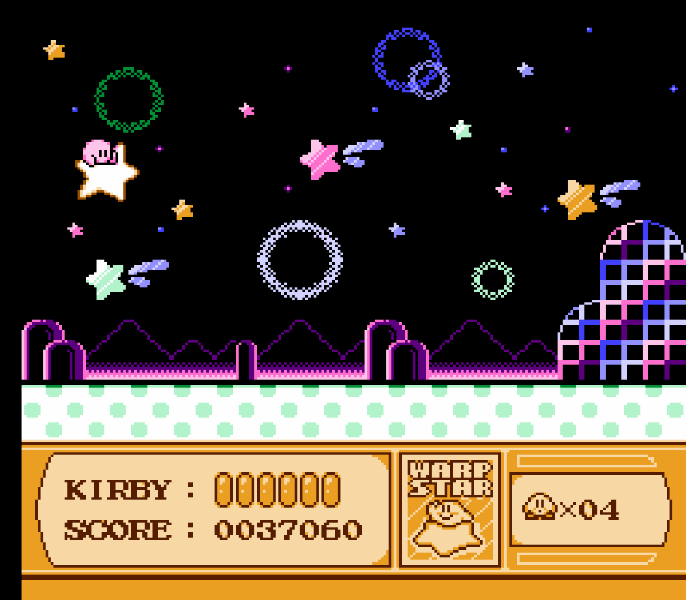
If the aim of your game is to be ‘cute’, you’ve got to supplement your cute visuals with equally-cute design, and Kirby’s Adventure’s got that in spades. I’m thinking of how getting hit initiates a mad dash to get your copy ability back, and failing to do so only asks you to get a new one, pushing your moveset towards different strengths and drawbacks. I’m thinking of individual moments, like an early stage giving you the incredibly fun 'Wheel' ability, then the next room being full of bottomless pits just daring you to try using it anyway; and I’m thinking about how broadly chaotic the levels are, each a string of bite-size rooms and challenges without necessarily having a strong aesthetic or kinetic throughline between any of them. I’m thinking of how light and silly the minigames are! I’m also a big fan of the push and pull of copy abilities: you can take one into an unsuitable part of a level, hoping you’ll get through and retain it for later; or you can drop it and lose it in favour of a better one in the short term. The 100% hunt to unlock Extra leans into this really well, often forcing you to take often-suboptimal abilities into levels and retain them for a long chunk of the level. Said hunt also extends the longevity of what’d otherwise be a ravenous charge through sets of extremely disposable 2-5 minute levels, encouraging replaying those levels multiple times and engaging with them slower and more carefully in order to find the hidden buttons; a straightforward romp being transformed into almost a light puzzle game just through the context it’s being approached under.
At the end of last year, I said that this year I wanted to focus down really hard on the things I know I like; exactly two days into the year I found myself wanting to instead start diving into platformers, a genre I have always had a very strained relationship with… oops. When I started thinking about it, I said to myself I wanted them not to be too hard but also not too easy, to not feel physically out of reach but also not feel unengaging; a sweetspot I’ve found very difficult to find. But maybe I’m just conflating difficulty with engagement and maybe the easier platformers I’ve played in the past just haven’t had enough going on, because this game isn’t hard but it’s incredibly dense; it feels like there’s always something interesting (or the potential for such) happening at every single moment, with the speed new level ideas are thrown at you and the myriad ways copy abilities can interact with and transform those ideas into meaningfully different challenges.
Also enough can’t be said about the game’s spritework!! These wizards pulled so much expressivity out of the NES’s fifty-two colours, the animations are so lively and detailed, it’s probably just one of the best looking games ever. This is a really special one, I think.
Touhou Kaikidan ~ Mystic Square
(plays stage 4) what the heck…. he did it again……..
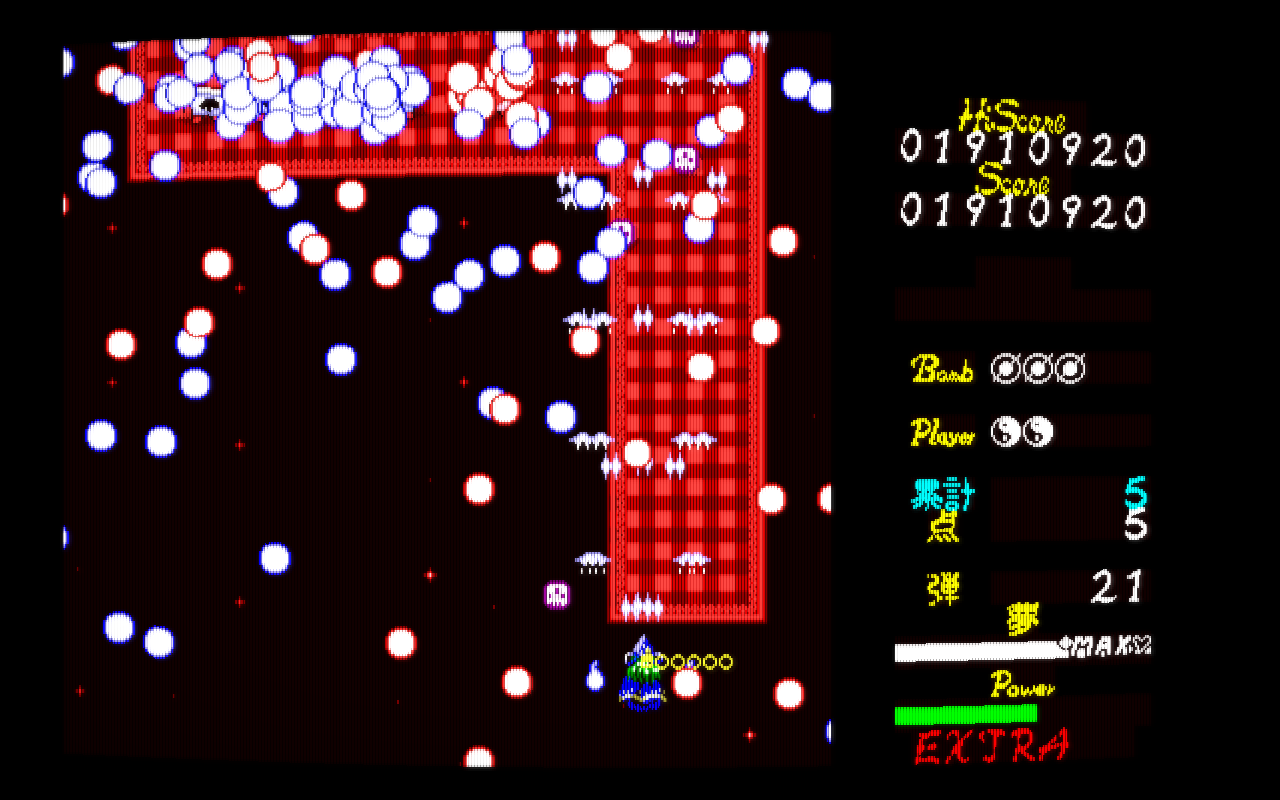
I’m really starting to appreciate the gameplay design here a lot, after revisiting them months after grinding out Windows Touhous. This is mainly noticeable through the bossfights: most of the later fights have multiple elements to keep track of that weave a welcome level of controlled chaos into everything; my favourite being Stage 4’s duo boss which swap between interacting with each other’s patterns and just firing two different ones at the same time, with the latter being very easy to get pinned in really uncomfortable positions by without really strong reading and pre-positioning. Boss patterns also often overlap with each other, coming out before the last one moves offscreen, making it very easy for bottom-hugging to result in getting pinned between two and encouraging playing a little further up on the screen to move up through the bullets before the next wave comes. In general, they feel like they push more skills than at least the easier Windows games do: those games often have very intricate patterns that feel very reactive, often not demanding much more than reading slightly ahead and wiggling through everything; while these ones have much simpler individual sections that expect noticeably more proactive play.
But it’s the confidence, the energy, the spectacle, that I love this one for, more than any specifics of the gameplay. Utterly unbelievable audiovisual bombast here; it’s the work of an artist who’s found their voice and knows it. From the first second, this game feels celebratory: the upbeat, encouraging melodies as you tear through enemies that haven’t even learned how to fight back yet, into stages that are some of the series’ biggest and most creative visual feasts even compared to the Touhous of today. Knowing that this would be the last PC-98 Touhou game before a four-year dormancy makes it feel like a very conscious ‘last hurrah’ for this era of the series, or perhaps even the series as a whole, if things worked out differently – putting absolutely everything into this final blaze of glory before taking a step away, a celebration of all the artist’s personal growth thus far. Having played the Highly Responsive to Prayers right before this, the jagged and incredibly competent first outing, it’s just as encouraging to me artistically to see what that rough little game would ultimately blossom into into, in just three years!! And the game culminates in the last two stages having you dodge through literal fireworks displays; if that’s not celebratory, then what is?
Pop'n Twinbee
I’ve been thinking a lot, as I’ve realised just how much I love these delicate, cutesy, candyfloss pastel-coloured aesthetics more than anything else in the world right now, how few games are allowed to be that whilst also being legitimately challenging; there’s ‘aiming a game at girls and kids’, and there’s ‘presuming girls and kids are incapable of playing a hard video game’. I’ve done a lot of specific hunting of my own, and it’s really hard to find things that satisfy both aches at once! And while I’m desperate for more to allow themselves to exist, I suppose it’s also why I’m so glad the ‘cute-em-up’ sub-genre was allowed to exist and flourish, bringing both together so joyfully.
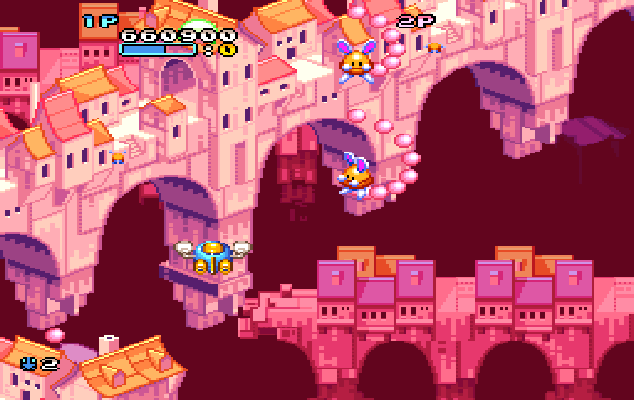
Anyway, this one’s cute! I like that the game’s entire resource economy revolves around juggling bell pickups with shots until they turn into the powerup you want, then having to stop shooting them to approach pick them up, oftentimes during sections with heavy enemy fire. Powerups stay important throughout the game – you always want four options active and your four-hit shield as healthy as possible, and even if both are full you’ll be trying to fish for bomb extends – so it’s a system whose dynamics are always present. Sometimes you’ll be making quick decisions on whether it’s worth it to stop shooting and risk your screen position to grab a good one, or just shoot the enemies and try as hard as you can not to reset it – other times you’ll be intentionally juggling a bell for half the stage because it just won’t give you what you want! It also feeds perfectly into co-op, as bells now being split between two players both means quick decisions on who gets what, and hoping that the other player doesn’t accidentally reset the really good one you’re trying to grab – especially when both of you are using the spread shot! The game giving so many resources makes it very forgiving, but also lets it leverage difficulty in a different way to typical shmups that focus more heavily on perfection: that really long section of Stage 4 that doesn’t give any items is the first time I’ve thought of a shoot-em-up as ‘attritional’.
I think this game generally glides through on mechanics more than it does on level design. Levels don’t often have particularly imaginative setups and feel like they often drag and wear their ideas far too thin before being willing to move on, but managing all of shooting, bombing grounded enemies, and juggling items still hits a very solid general level of engagement through all but the most eye-rolling pacing. Bosses are impressively simple, but have room to optimise with spread-shot shotgunning as well as the awesome dedicated ‘punch’ button. It’s got surprisingly nasty sections, but the resource game as well as the general low difficulty made my first full 1p play only drop its first continue near the end of the final stage. It’s probably best with 2 players, not just because of the previously-mentioned dynamics but also because of the two extra dedicated abilities: equalising both of your health, and being able to throw your partner as an invulnerable bouncing projectile weapon – both rather silly, but having to position on top of each other adds even more chaos to some otherwise exceptionally silly new options. It’s not a game I can see myself wanting to grind, especially for being a shmup that pushes a 50-minute runtime!, but I think I’ll always enjoy it whenever I can find someone to drag in with me.
Judgement Silversword: Rebirth Edition
Woah. Woah woah woaaaahhhhhh.
My shmup experience so far is largely limited to Touhou, CAVE shooters, and things that play quite a lot like them, but the first one I play with a wildly different format just feels immediately perfect. Rather than minutes-long stages capped off by a boss, it’s an uninterrupted string up of 10-30 second micro-levels that beg full optimisation: killing enemies fast builds up a score multiplier, killing enemies fast spawns *more* enemies faster, clearing the area fast gives a further score bonus at the end, and missing enemies or killing them inefficiently shuttles the multiplier all the way down. It’s build around hard, very focused score-play that rewards high optimisation with a continuous flood of extends: survival is scoring, and as such forces much more aggressive positioning and dodging than any other shmup at the level I’m playing at, where enemies can oftentimes be left alive for a long time until they naturally end up in the line of fire.
The structure allows the game to lay down a very clear idea of ‘perfect’ – kill every enemy, kill them riskily, kill them as quickly as possible. Letting just a single enemy escape an area makes it abundantly clear that there’s improvement to be made, and clear enough for it to be immediately actionable. Bumbling through the early areas turns to gliding, turning from “how do I full-clear this without dying” to “how do I do this as quick as humanly possible” to “how do I do this as quickly as possible with as ridiculous a multiplier as possible” as the later, tougher areas slowly start to enter the same cycle. It’s a process that’s both humbling and motivating: pushing for hyper-optimisation gives you even more room to mess up even on the early stages, and makes it clear that you’re playing tougher areas at a fraction of the level you’re being expected to, but that inversely makes any level of improvement feel fantastic; I’m popping off after frame-perfect optimising an area less than a minute into the game, while pushing survival progress near the end. It brings you face-to-face with how much improvement you could be making – improvement that’s attainable but just out of grasp – and keeps mentally moving the goalposts until you’re chasing genuine perfection before you know it. Really special stuff.
Cardinal Sins
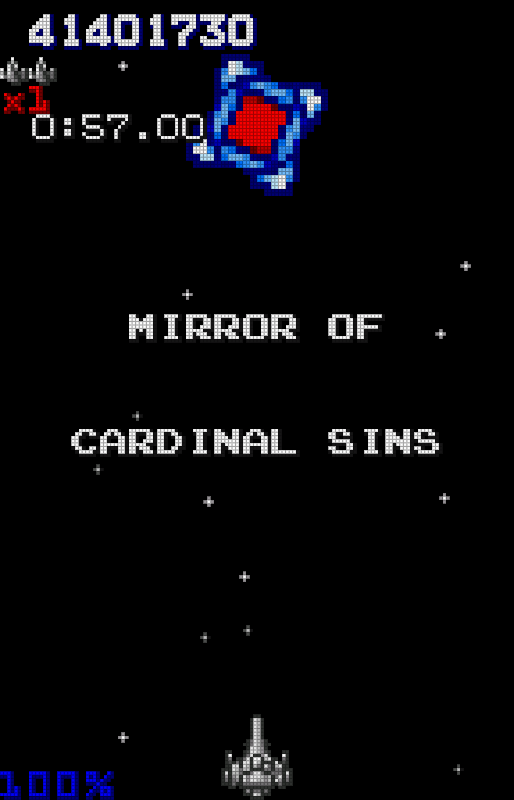
Saaaadly not so hot on this one. It’s built almost exclusively of asset reuse from Judgement Silversword, but deviates heavily from its structure by instead being comprised of seven ‘minigame’ stages each with different objectives: sometimes you have to speedkill enemies or survive a certain amount of patterns, sometimes you have to achieve more out-there objectives like collect a certain amount of extends (which you can now destroy by shooting them!) or ‘scan’ enough enemies by causing as many unique interactions as possible: destroying them, allowing them to shoot, destroying particular bullets, etc. This one bristles against me for a few reasons: it starts off really easy and ramps up really hard – the first few stages don’t really feel like you’re playing much!, the objectives aren’t really doing all that much to the shmup formula or even to JSS’s mechanics, and scoring and survival are completely opposed playstyles. You don’t need to perform well to see the final boss – just not run out of lives on any of the stages – and since all the stage gimmicks are fully built around scoring rather than survival… playing just to clear means not having to engage with the gimmicks at all. It’s a bit of a shame, after JSS proper ties scoring into survival so well.
Love that this exists, though!! It’s cool to see a game explore some kinda weird ideas like this does, and use the previous game’s assets so generously presumably in order to reduce the overhead of making something like this as much as possible.
Metroid Fusion
I find it really evocative that, as Super very disappointingly slips into even harder, more bombastic power fantasy after II takes a critical lens to exactly that, Fusion has to swing the pendulum back even harder. This is a story not just about killing, but about Samus Aran, casual wildlife exterminator; the X parasite acting with clear intent to kill and puppet all life on the planet as a means to kill her, with the SA-X acting as Samus at her strongest, coldest and most destructive, is her continued willingness to kill even after the events of II being reflected back onto her. The way the X act is my absolute favourite part of this game: puppeteering and twisting harmless creatures into hazards, intentionally creating enemies directly in your path, and regenerating themselves unless you absorb the killer parasite into your own body; the X themselves being the healing drops is grotesquely evocative. And I'm almost obsessed with the intro shot of Samus being attacked by the parasites, how it shows nothing and leaves absolutely everything to imagination; any less restraint would make it so much weaker.
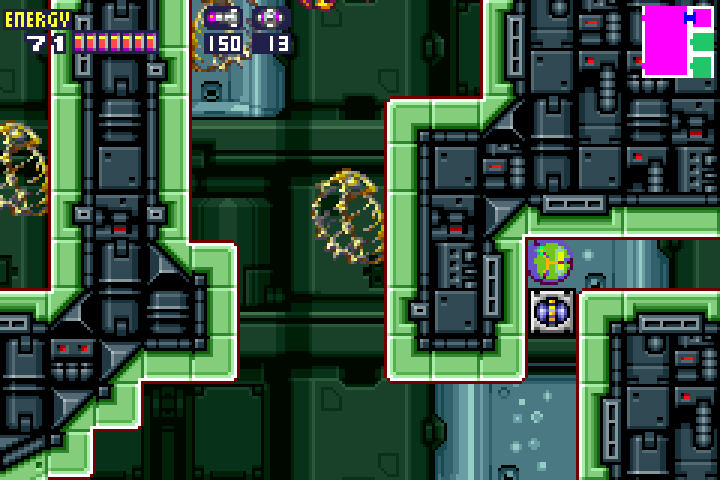
Unlike II’s cold, dry presentation and often empty-feeling levels perfectly fitting that game’s scenario, Fusion feels a little too by-the-books to really push any of its narrative or thematic feelings through play, though. Level geometry and enemy placement have never felt hostile enough to tease out the sense of dread the game feels like it’s trying to exude, on top of some slightly grating niceties: breakable blocks telling you the powerup you need, very clear Tutorial Sections for a new powerup, designated Eyeball Doors before boss rooms to ensure nothing surprises you; all feel as though they’re pulling back the curtain a little too much on what is trying to be an – admittedly fairly cinematic action – horror-esque experience. It’s maybe worth noting how vestigial so many elements feel at this point: through the game’s structure and levels causing upgrades to not recontextualise physical space in a particularly interesting manner, they almost just feel tacked on as a series staple and a simple ‘carrot’ to chase to allow the game to keep giving you specific objectives. What I gripe with the most is the use of the morph bomb: there doesn’t exist the same combat application or bomb-block navigational puzzles as in the original Metroid, so its main application is having you bomb clearly-telegraphed dead-end floors until you hit the two blocks that open up, or to make it glow with the attack you actually needed to use on it to open. Why am I bombing a floor in order to find out I actually needed to missile the floor to open up an obvious critical path? I dunno, it kinda sucks!
The Guardian Legend
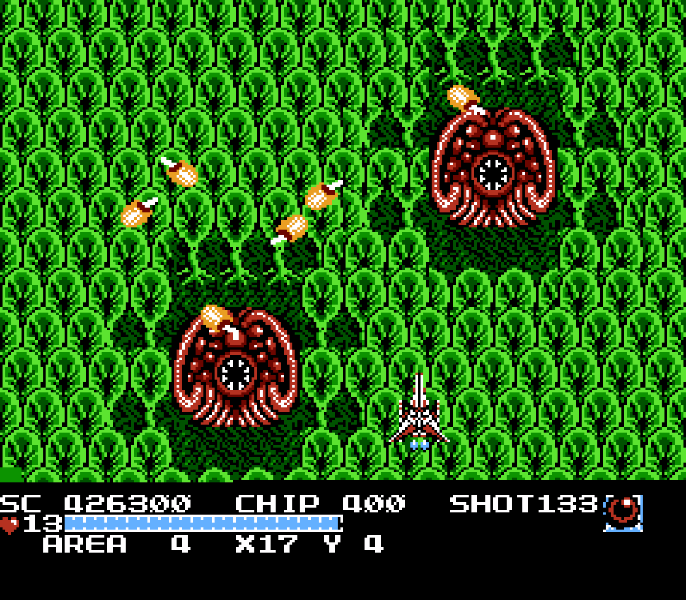
Every element in this weird little thing feels at odds with itself. The top-down crawler-shooter sections impressively lack quite literally any sort of room design, instead spawning the room’s designated enemies in random positions when you enter them, taking long enough to spawn to where it’s very often more ideal to simply run through before they become threats. It’s moreso a vessel to gain subweapons and statistical powerups, fight the occasional miniboss, and solve light puzzles to access the vertical shmup sections, whose genuinely quite interesting enemy design get completely plowed through by those powerups as well as the randomly-dropping health pickups that almost feel like they slipped into the shmup sections by accident, leaving them often just feeling like aesthetic showcases as a run-up to a boss – until the twilight stages, where the combination of a kind of pathetic-feeling standard shot, extreme enemy and bullet density compared to screen and player-hitbox size, and the resulting performance and readability hit the game takes from that, twist away from any last hope of feeling like a normal shmup and become more of a puzzle of finding the correct subweapon to tear through everything before it can tear through you.
Nothing feels like it works very well, and yet I think I still quite like it! Playing the shmup sections as if you can’t just damage-tank through every enemy in most of them occasionally reveals some very sharp levels and bosses, with my personal highlight being attempting the early Corridor 12 without having explored any of the levels around it, forcing me to learn the stage and the mechanics of the weird, suffocating enemies to a very satisfying (and a little painful!) degree. Going back and playing the secret password 'TGL' for a little bit… certainly exemplifies the pain points of the levels, but also makes me pine for shmup enemies that control space just as annoyingly as some of these do. And I can’t help but shout out the environments in this: I’m playing as a spaceship, but soaring through dense jungles and oceanfloor surfaces fighting off enormous bugs, plants and deepsea creatures. The crawler-shooter sections aren’t as inspiring in either way, but I found the core of it fun enough to feel starving for something similar… do I need to get on the Pocky & Rocky grind, is Blaster Master the best game ever… But ultimately, even though it feels like its most interesting ideas end up drowned out by anything else, it’s been a romp I’ve had a good enough time with – and it’s made me want to explore some other things, too.
Bubble Bobble
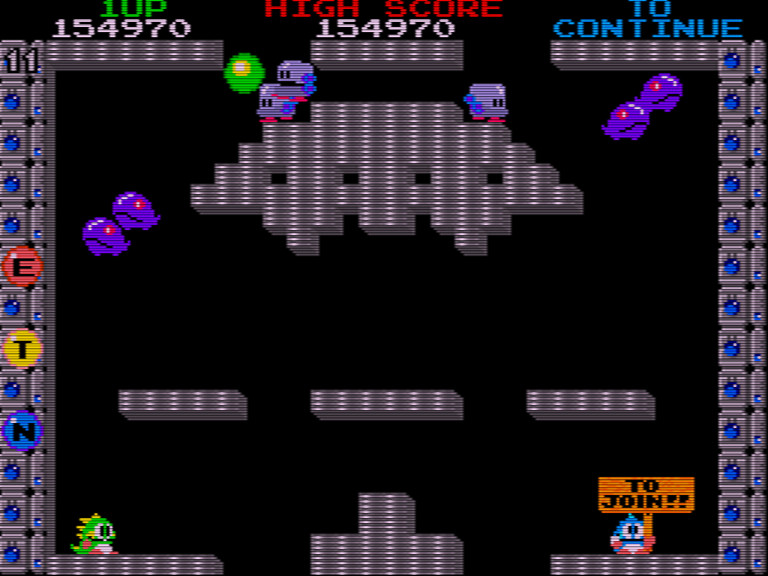
Initially, I found this a bit underwhelming. The scoring system – trapping multiple enemies in a continuous chain of bubbles and popping them all at once – is really cool, weighing the reward of getting a massive chain against the risk of bubbles timing out and the enemies becoming faster and harder to deal with – except both score extends are easily achievable in the first five minutes, making the whole dynamic pretty pointless now divorced from the physicality of the arcade. And what was left was a pretty straightforward yet tricky single-screen shooty platformer that, due to a lack of continues, I was only able to penetrate about a sixth of this game’s dizzying one hundred levels.
So, I did what any normal person would do upon learning that 2p allows continues: I trapped one of my friends in a bubble and forced her to play through the whole thing with me. Diving into the game's deeper levels forced it to reveal its hand: that being a game with sooo many little manipulable details in its unassuming package, and one that, by the end, will force you to reckon with all of them. Attack bubbles! Bubble speed! Bubble movement paths! Bubble timers! Level timers! Bubble jumping! Manual bubble movement! Tile collision quirks! The game intersperses all its varied elements very erratically, with a fairly loose regard for a difficulty or complexity ramp up until its twilight levels – one level you'll be fumbling strict bubble jumps against a timer in a level where your bubbles don't carry you upwards, the next might just be very straightforward action platforming with no catch. And those later levels start to feel almost ‘kaizo’-like: not in terms of pure difficulty but how far they push extreme particularities about the mechanics, and expect you to intuit and respond to them. There’s such little consistency to this game – sometimes in a way that feels like it bristles against core elements of the thing that I really like – but I think that’s far outweighed by how far and how chaotically it pushes every single possible facet of the game. It’s such an interesting, weird, misshapen little thing!
I don't think this all coalesces that well for me, to be honest – it’s absolutely a game that I respect quite a lot more than I actually enjoy – but it’s neat! It’s cool! It’s the world’s greatest vocal stim! Bubble Bobble! Bubblebobble! Bubbobobbbobboblle!!!
Gunstar Heroes
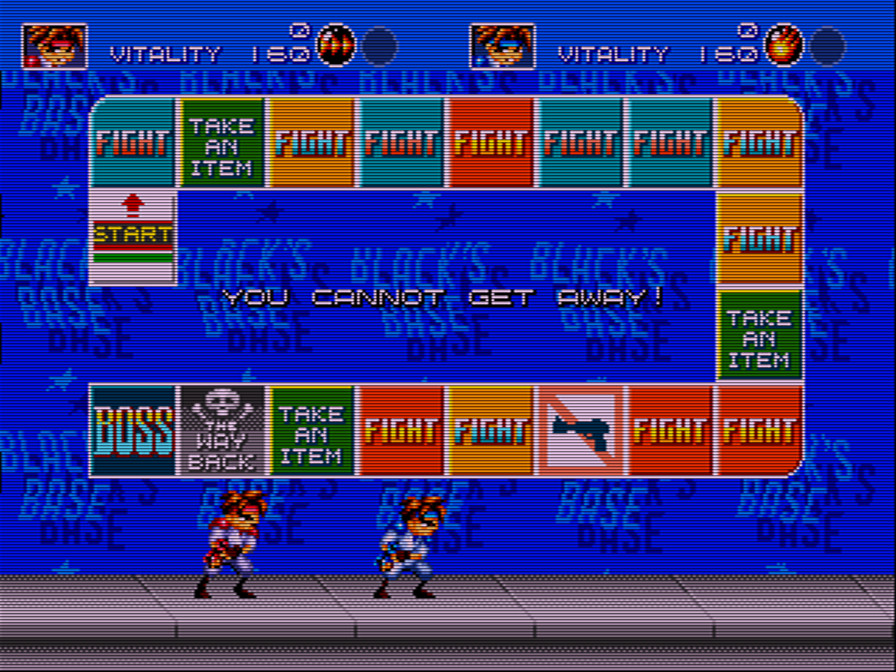
Jumping back into the first level of this reminded me why I had such a low first impression of it when I tried it four years ago: a really simple and dull set of stages punctuated by some very straightforward bosses was enough to make 2022 faea immediately check out of this one. And I can't say I disagree with her on the stages at all: they're very chaotic whilst being very simple, rewarding basic actions with a level of overstimulation that makes the screen feel like it's melting – it feels as though it's trying to make me feel so cool for actions that are decidedly not cool, which makes me feel very cynical towards it! And the chaos does no good for the actual play of the stages, either; at least in my case, I could rarely ever tell what it was that’d damaged me. But the majority of bosses are the complete opposite of this, being much calmer sensorily while demanding interesting applications of different parts of your toolkit; all the little tricks you pick up whilst fighting individual bosses then being generalisable to the rest of the game, giving that replay depth any good arcade game ought to have.
I wouldn't see myself playing this alone, but it's been a good time playing with a friend who's much more passionate about it. And it's made me think a lot about co-op dynamics, as a lot of co-op games I've played in the past almost felt like playing two singleplayer games while sharing the same space. This game’s got a very simple but very strong importance on not interfering with your co-op partner’s space, else you’ll start accidentally throwing each other or lead aimed attacks into each other, not being able to tell who’s being aimed at. The latter makes it important to sometimes not share the easiest space to dodge a particular attack; it might actually be easier to stand somewhere otherwise unfavourable. And I think all the conferring and strategy-sharing we had during Dice Palace made it feel like the world’s best teambuilding exercise, despite it being played one person at a time!
We didn’t finish it, but every retry of the 5th stage sort of reverted me back to how I felt about it way back then. Maybe video games can suck sometimes
~*ʚїɞ*~
Thank you for reading, as always. It’s been nice seeing my intent to focus down immediately pay off; I’ve really liked practically everything I’ve played (or at least actually put time into!), and I think I’m starting to feel more passionate about these things than I have in quite a while – maybe visible through just how many games I’ve put on here this month!! The time I’ve been putting into playing things on Fightcade recently, and by extension exposing myself to a bunch of things I’ve never seen or played whenever I open it, or type anything into the search bar, has twigged a bit of a stronger interest in earlier arcade games, the ones of the 70s and early-mid 80s, so I’d like to pursue that a bit more in the near future.
And don't forget to read my most recent piece, as well. Love you all. See you next month. ~♡